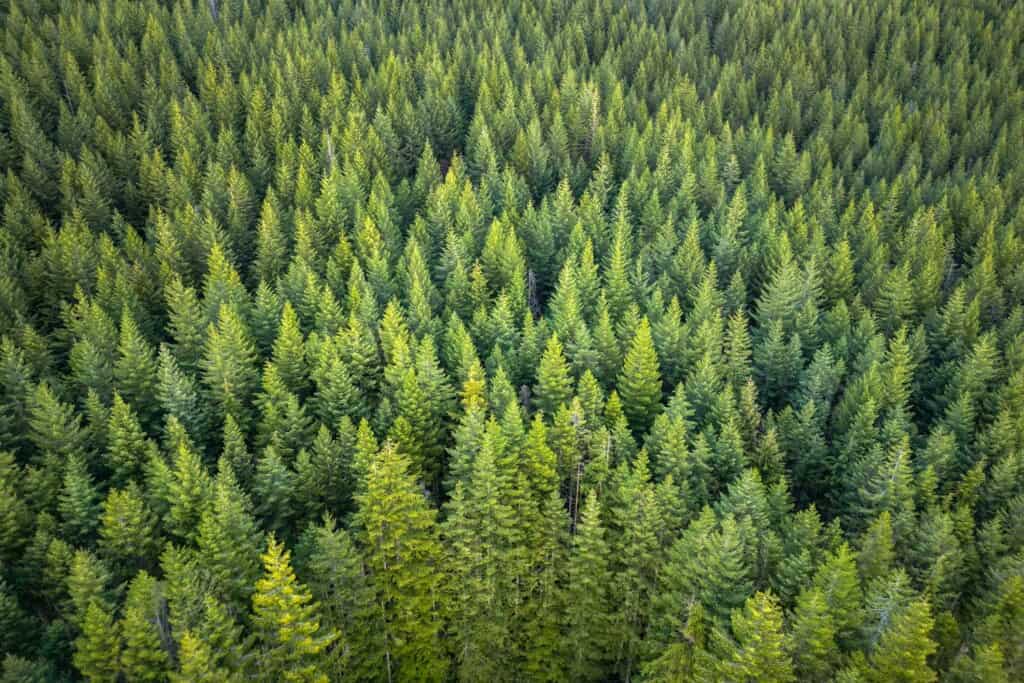
Evergreen forest on Vancouver Island, British Columbia, Canada.
For decades, the Pacific Northwest has occupied a particular place in the North American coffee imagination: thoughtful, origin-forward, quietly exacting. Long associated with washed coffees, restrained roast styles, and a reverence for clarity over spectacle, the region helped codify what many drinkers still think of as “clean” coffee. Today, however, that definition is expanding — without abandoning its roots.
Across Washington, Oregon, Idaho and Western Canada, roasters are increasingly willing to explore advanced fermentation techniques, coferments, and hybrid processing styles, even as they continue to prize balance, structure, and drinkability. The result is a regional coffee culture that feels both grounded and exploratory: In our cupping, this resulted in turning up coffees that invite curiosity without demanding palatal acrobatics.
This year’s sampling of top-rated Pacific Northwest coffees reveals a throughline of controlled risk — fermentations that are expressive but not reckless, blends that feel intentional rather than convenient, and everyday offerings that punch far above their weight.
Blends With Purpose: Reimagining the Role of the Everyday Cup
Few regions take blends as seriously as the Pacific Northwest. Rather than treating blends as secondary or purely commercial offerings, many roasters here approach them as compositional exercises, built for balance, longevity, and repeat pleasure.
Boon Boona’s Bereka Blend, sourced from Ethiopia and Tanzania and fully wash-processed, exemplifies this ethos. At 93 points, the coffee balances floral lift with grounding sweetness and savory undertones, offering complexity without volatility. It’s a blend that drinks like a single-origin narrative, unified rather than fragmented.

A traditional coffee ceremony at Boon Boona, the inspiration for the Bereka Blend. Courtesy of Boon Boona.
At DOMA Coffee Roasting Company, a Colombia Nariño (93 points) blend that includes Geisha, Caturra, Colombia and Castillo varieties of Arabica highlights how Northwest roasters approach even celebrated varieties with humility, here adding the venerated Geisha into the mix. Floral and tea-like, the coffee avoids excess aromatic exaggeration, instead delivering a poised and readable expression of coffee’s perennially hottest variety of Arabica.

The DOMA roastery in Boise, Idaho. Photo by Alyssa LaBenne.
Ian Nelson, who works in production and quality control at DOMA speaks to the company’s intentions across all coffees: “Our roastery is a passion project fueled by great coffee, along with music, biking, cooking, reading and adventure, and our culture is to use our work for good in all the communities we are part of.” He says their team loves this coffee for its delicate sweetness, florality and crispness, a description that pretty much nails our experience of the coffee.

Ian Nelson, DOMA’s production and quality control manager, cupping samples at the roastery. Courtesy of DOMA.
Similarly, Nemesis Coffee’s The Juice Everyday Filter (93 points) underscores another Pacific Northwest constant: the belief that daily coffee should never be an afterthought. It’s a blend of Honduras, Ethiopia and Brazil coffees — bright, fruit-forward, and unapologetically pleasurable. It manages to feel both fun and intentional in a balancing act that roasters in the region seem to have quietly mastered.
Finally, Olympia Coffee’s Little Buddy (94 points) reinforces how seriously Northwest roasters take accessibility. Designed as a year-round staple, the coffee nevertheless delivers layered sweetness, crisp acidity, and a surprising elegance that belies its positioning as an “everyday” option. Owner Oliver Stormshak (who has just sold the company and will focus on Oliver’s Custom Coffee) says, “Named after my sister’s first car when we were teenagers, Little Buddy is a blend of African coffees that takes an inexperienced palate to new places in a vehicle that’s fun and exciting to roll with.” We love it when a brand’s narrative meshes with our experience of the cup.
Fermentation as Craft, Not Gimmick
If there is a defining shift in the Pacific Northwest today, it is the normalization of fermentation experiments, approached with thoughtfulness and intention.
Pine Coffee’s Seriously Fun (94 points) is a coferment that lives up to its name without crossing into novelty. The coffee presents bright, confectionary aromatics and juicy acidity, but retains a clear structural backbone. This is fermentation deployed as enhancement, not disguise.

Producer Marlon Rojas on his family’s Huila farm. Photo by Cody Hamilton.
Roaster and partner Cody Hamilton says Seriously Fun encompasses Pine’s coffee philosophy: “We take the art and science of coffee very seriously, but life is too short not to have fun.” This one is a passionfruit coferment produced by Marlon Rojas at his family’s farm in Pitalito (in Colombia’s Huila Department).
At Oliver’s Custom Coffee, an Ethiopia Rumadamo Anaerobic Natural (95 points) explores a deeper, more sultry fermentation profile. Tropical fruit, cocoa, and gentle booziness appear, but are kept in check by careful roasting that preserves sweetness and avoids muddiness — a hallmark of restraint. We knew it was a special coffee when we cupped it blind; come to find out, owner Oliver Stormshak processed it himself.

Oliver’s Custom Coffee Ethiopia Rudamamo drying on raised beds. Photo by Oliver Stormshak.
Stormshak was in Ethiopia when we reached him to ask about this coffee and had just visited Rudamamo. He says, “We source our coffees directly from producers globally. This coffee is sourced in partnership with the Ethiopian exporter Daye Bensa. The importer we use for our Direct Trade bespoke coffees in Ethiopia is Royal Coffee under a Direct Trade Contract with Royal Coffee.” The result is a unique collaboration that excels in the cup.
Origin Transparency and Producer Recognition
Despite the growing interest in processing innovation, the Pacific Northwest has not abandoned its longstanding respect for producer-driven distinction. Several standout coffees in this year’s lineup underscore the region’s continued investment in honoring producers, naming specific varieties, and green-buying coffees with traceable origins.
Evans Brothers Coffee’s Guatemala Maria Gaspar Escobar (93 points) offers a composed, articulate cup that emphasizes clarity, sweetness and clear expression of the Bourbon variety. The coffee’s appeal lies not in spectacle, but in its seamless integration of acidity, body, and finish.

The Evans Brothers team. Courtesy of Evans Brothers Coffee.
Co-owner Randy Evans says, “Atlas Coffee Importers does a great job of connecting its roaster clients with producers. In 2019, founders Rick and Randy Evans were invited to join an internal competition at the CODECH Cooperative, hosted by Atlas. Maria Escobar’s coffee landed in the top 10 (5th place), and we purchased all of her coffee from the competition. We have continued buying Maria’s coffee since 2019, paying her a quality price premium each year.”

CODECH, the Guatemala Cooperative where Randy and Rick Evans were first introduced to Maria Gaspar Escobar’s coffees. Courtesy of Evans Brothers Coffee.
Portland-based Proud Mary’s Rock Anthem (92 points) is an El Salvador Pacamara whose producing family the roaster has worked with since 2011. Emilio López Díaz of Finca El Manzano has brought the family tradition fully into the 21st century by collecting and applying data and metrics to post-harvest processing, and he’s also planting varieties not typically found in El Salvador, such as Geisha and SL-34.
Oregon’s High Bar for Technical Excellence
Oregon continues to push the upper limits of technical precision, with coffees that combine adventurous sourcing with meticulous execution.
Elevator Coffee’s Colombia Finca El Diviso Java earned the highest score in this cupping at 96 points, a testament to both exceptional green coffee and exacting roast development. The cup is layered, vibrant and deeply sweet, showcasing how varietal exploration can flourish when supported by rigorous quality control.

Elevator Coffee’s Andrew Coe and Jarrod Smith cupping sample roasts at the 2025 U.S. Roasting Championships in Houston, Texas. Courtesy of Elevator Coffee.
Co-owner Andrew Coe, a 2023 U.S. Coffee Roasters Champion, says, “Our roasting style and philosophy is to be detail-oriented, quality-obsessed, always improving, and to let the coffees speak on their own terms.” Of this particular coffee, he adds, “We have been buying coffees from Finca El Diviso since 2023. This Java lot has received high praise for its exceptional floral aromatics, coupled with a lovely acidity, which come together in a harmonious balance in the cup.”
Meanwhile, Bows Coffee Roasters’ San Pedro Yosotatu washed coffee (93 points) offers a quieter but equally compelling narrative, built on polished acidity, gentle florals, and a long, resonant finish. The Victoria, BC roaster has been working with this community’s coffees for nine years, and this coffee beautifully and transparently reflects the nature of Oaxacan Bourbon.
What It All Means
Taken together, these coffees suggest a Pacific Northwest coffee scene that is neither reactionary nor static. Roasters here are embracing fermentation, variety, and stylistic play — but on their own terms. Cleanliness has not been abandoned; quite the contrary — it has been redefined to include expressiveness, so long as structure and balance remain intact.
If the region once set the standard for clarity, it now appears poised to redefine the range of what that can taste like in an era of global experimentation.
Thanks to Jason Sarley for co-cupping all coffees reviewed in this report.
Source link