
Key takeaways
- Two-thirds of South African adults now drink coffee daily.
- Instant coffee still dominates, with 76% of drinkers preferring it.
- Cities like Cape Town, Johannesburg, and Durban are becoming specialty coffee hotspots.
- Price sensitivity still remains a barrier for South Africa’s specialty coffee market.
As the exclusive producer of rooibos tea, South Africa has always been a predominantly tea-drinking country. However, the majority of adults in South Africa – up to two-thirds – are now drinking coffee daily.
The earliest documented consumption of coffee in South Africa traces back to the arrival of Dutch colonisers in the mid-17th century.
“There are many stories of people sitting around fires in the early mornings drinking what the locals call ‘moerkoffie’ or ‘boskoffie’,” explains Chris Rootman, Chairman of the Board of the Specialty Coffee Association of Southern Africa and Sales Manager of the South African roaster TriBeCa Coffee. “The tradition refers to grinding coffee into a kettle or pot, boiling it over an open fire, and then sweetening it with condensed milk.
“It’s still a popular method of drinking coffee when camping or going on holidays in the bush,” Chris says. “Until the late 20th century, this style of coffee, as well as chicory-based instant coffees, dominated the market.”
Today, an estimated 76% of South African coffee drinkers prefer instant coffee, and the rest drink brewed coffee. The nationwide prevalence of instant coffee and coffee mixed with chicory – a root that can be roasted and ground – has persisted due to its economic necessity.
More recently, South Africa’s specialty coffee scene has started to blossom in major cities like Cape Town, Johannesburg, and Durban – and there’s potential for it to keep growing.
You may also like our article on why Indonesia’s coffee market is thriving.

Understanding South Africa’s coffee market
Economic class has long defined South Africa’s coffee consumption. International trade sanctions against apartheid-era South Africa in the late 1900s made coffee imports extremely expensive. Only those who could afford it drank brewed coffee; the rest made the most of the scarce import by mixing instant coffee with locally grown, cheap chicory.
Until the 2000s, only chicory instant coffee was affordable for many Black South Africans growing up economically suppressed during apartheid. Affordability is still a strong market driver due to class divides and South Africa’s 32% unemployment rate.
“Because of economic status, coffee is still a perceived luxury in South Africa, where a large part of the population can’t afford to drink coffee,” Chris says.
In 2021, the South African government began regulating chicory “coffee” because many popular brands in South Africa actually contained only 25% coffee, 33% chicory, and the rest fillers – and few disclosed it. The government required transparent labelling, marking another rise in standards in the South African coffee market.
South Africa’s specialty coffee culture only began to challenge tea and instant coffee consumption in the early 2000s. In the 2010s, brewed coffee became more accessible, and consumers started shifting away from instant coffee.
According to Chris, the South African at-home coffee market remains driven by chicory, instant, and freeze-dried coffee, especially for lower-income populations. However, whole bean sales have been picking up since the mid-1990s as retailers cater more to middle- and high-income consumers, he tells me.
The tradition of instant and chicory coffee developed the South African palette for strong, bitter coffee. The mass market prefers medium- to dark-roast coffee blends using both natural and washed coffees, while experimental process coffees and single origins are still seen as niche, Chris says.


Specialty coffee grows
South Africa’s coffee industry is still dominated by large commodity roasteries, but demand from a handful of smaller independent roasters in the last decade sparked an increase in specialty-grade coffee imports.
By the mid-2000s, specialty coffee shops had bloomed across major cities such as Cape Town, Johannesburg, and Durban. Cape Town has become an international coffee capital with over 70 specialty cafés and many independent roasters.
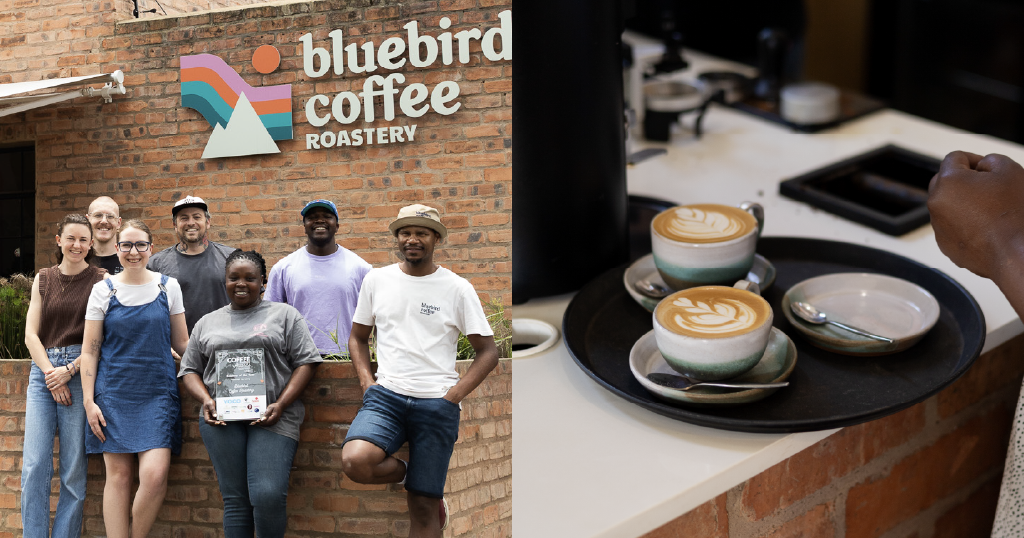
By no means are these cities the only places to find specialty coffee. For example, Bluebird Coffee is based in the small town of Howick, over an hour inland from Durban.
Like many millennials growing up in South Africa, Dario – the founder, green buyer, and head roaster at Bluebird Coffee – was first introduced to coffee by the scalding hot instant coffee his parents drank. It wasn’t until adulthood that Dario’s friend introduced him to “properly-brewed coffee” and specialty cafés, he says.
South African food and coffee chains have played a large part in helping entry-level specialty coffee reach the masses. At the turn of the 21st century, comical television ads by the fast-food chain Wimpy introduced a broader consumer base to specialty-style drinks like cappuccinos.
“The vast majority of cafes in South Africa would tell you that their most popular drink would be a large cappuccino,” Dario says.
Starbucks further popularised specialty-style drinks in South Africa when it opened its first café in the country in 2016. Today, the coffee chain Platō is rapidly expanding into communities across the country where specialty coffee was once inaccessible.
Other main coffee culture influences come strongly from Australia, largely due to the high rates of immigration and travel between the two regions, as well as Europe, the US, and Asia. Dario tells me that high-end specialty roasters pay most attention to European coffee industries, such as Scandinavia.
Younger consumers are driving the trend
Rising consumer knowledge about coffee is shifting their preference to specialty coffee. Bluebird Coffee is having “much higher-level conversations” with its average customer-base compared to five to ten years ago, Dario says.
Younger generations in particular are seeking unique coffee experiences, and high-quality coffee that supports traceability, ethical sourcing, and environmental responsibility – and they are willing to spend more for it.
“We are moving in the right direction. I’d say we’re probably five years behind the US and Europe,” Dario says. “Whether it’s roasting microlots and Geshas and all these amazing coffees that we get to share with our customers, or if we’re talking about more accessible everyday coffee, I think the standard is rising steadily over time.”
The spiking out-of-home market is led by coffee shops strongly focused on espresso-based drinks. South African coffee shop culture largely skipped over the filter coffee stage, with the exception of specialty roasters’ coffee shops. Dario and Chris say it’s rare to find a café that serves batch brew or pour over.

Keeping momentum
Chris expects South Africa’s coffee industry to continue to flourish. “There are several big franchises with aggressive expansion plans for the next five years,” Chris says. “As our out-of-home market is growing, we are creating more and more employment in the industry, specifically for baristas, where we are able to educate and uplift people from all different walks of life.”
Already, South African coffee shops and roasters are gaining international recognition. Espresso Lab in Cape Town was named the 40th best coffee shop in the world, and Bluebird Coffee recently won Coffee Magazine’s South Africa Roastery of the Year.
Meanwhile, more and more annual coffee events – like Creative Coffee Week in Durban and the Coffee Fest in Johannesburg, Winelands, Pretoria and Cape Town – are stoking excitement about specialty coffee and accelerating local innovation.
“Being such a small industry compared to the rest of the world, very big changes can happen quite quickly,” Dario says.
Realistically, the specialty coffee industry needs swift change on the economic front in order to sustain its growth.
“One of the things that holds cafés and roasteries back is people’s sensitivity to price. We can only charge a very low price for our coffee compared to the US or Europe, yet our costs are quite high,” Dario says. All things considered, he remains optimistic that the industry will see more accessible specialty coffee in the future.
“If people are willing to spend a lot of money on a matcha, hopefully we’ll see the same willingness for high-quality coffee,” he says.
Revitalising South African coffee production
Alongside its history of coffee consumption, South Africa also grows coffee.
The first coffee in South Africa was planted by British colonisers in KwaZulu-Natal in the late 1800s. Commercial coffee plantations spread to the Limpopo Province by the 1960s, and high international coffee prices incentivised the government to expand coffee production in the 1970s.
The late 1980s were South Africa’s peak decade for coffee production. It produced 1,800 tonnes of green coffee in 1987 and projected its coffee production to expand rapidly over 1,000 hectares. But fast-forward to today, and only 200 hectares are under coffee production, and peak coffee production in the last decade was only about 120 tonnes.
These setbacks, plus the high cost of labour, low coffee prices, and competition from cheap imports, led to most farms closing down.
Today, coffee production costs are relatively high, and the vast majority of coffee consumed in South Africa is imported. In part because South Africa isn’t a member of the International Coffee Agreement, much of its imported coffee has long been low-quality, dominated by robusta and instant-coffee-quality beans.
The momentum around South African-grown coffee is growing, but not yet at a volume that challenges the commodity market. “Some very dedicated farmers and producers in South Africa are working hard to increase quality and quantity,” Dario says. While a promising prospect, “we are not achieving high-scoring coffees yet.”

South Africa’s coffee scene is changing fast. Specialty cafés are expanding beyond major cities, younger consumers are demanding higher quality, and local roasters are earning international recognition.
The challenges, particularly price sensitivity, are real. But in the wake of the country’s economic resilience over the last few turbulent years, the industry has the foundations to keep growing.
Enjoyed this? Then read our article on how Turkey’s specialty coffee market is evolving.
Photo credits: Bluebird Coffee
Perfect Daily Grind
Want to read more articles like this? Sign up for our newsletter!
Source link