
Key takeaways
- Hospitality at competitions deserves equal attention alongside coffee and technique.
- WBC judges now ask whether they felt genuinely considered.
- Competition-level hospitality translates directly to daily café service.
- Intentional, consistent actions can elevate customer service.
Competitions, most notably the World Barista Championship (WBC), are best known for showcasing rare coffees, precise extraction techniques, and an attention to detail that defines specialty coffee.
But there is another element to competitions that tends to receive less attention: hospitality. How a barista guides the judges through their routine, manages their presence on stage, and communicates under pressure are skills that translate directly to cafés worldwide.
“Coffee is easier to talk about,” says Alica Bánszka, a World Coffee Championship Certified Sensory Judge and head roaster at Rebelbean in Czechia. “Flavour notes, processing methods, and brewing parameters are tangible and technical, so they tend to dominate the conversation. Hospitality is more subtle, but it’s present throughout the entire experience.”
You may also like our article on why there’s more focus on customer service than ever before.

Coffee comes first in competitions, but hospitality is key
Throughout most of the WBC’s history, the competition rewarded technical mastery above all else. Sourcing, roast profiles, and brewing parameters dominate competitor presentations, and the coffees themselves, often Geshas or “rediscovered” varieties selected for their flavour complexity, became the centrepiece. Hospitality, by contrast, was harder to quantify and easier to overlook.
“Coffee is easier to measure, while hospitality is easier to feel,” says Dominika Piotrowska, a two-time Austrian Barista Champion and a Coffee in Good Spirits Champion. “Flavour, extraction, and technical execution are tangible, but hospitality is more subtle. It’s about intention, awareness, and emotional intelligence – things that don’t always announce themselves loudly on stage.
“Many competitors do execute hospitality well, but they don’t always frame it clearly as a conscious choice,” she adds. “Another reason is legacy. For many years, WBC culture rewarded technical skills the most, so competitors naturally focused on what they believed would ‘score safest’.”
In more recent years, however, the focus has shifted. “Judges now aren’t just tasting coffee,” says Dominika. “They’re asking, ‘Did I feel considered?’ That’s where hospitality becomes impossible to ignore.”
WBC score sheets now reflect this shift. As per section 13.1 in the 2025 WBC Official Rules and Regulations, the judges are “looking for a champion who has a mastery of technique, craft, and communication and service skills, and is passionate about the barista profession… and may serve as a role model and a source of inspiration for others”.
“We evaluate not only the beverage but also how the competitor communicates, how the drinks are presented, and how the experience is guided,” says Alica. “A great coffee served without hospitality is still good, but when hospitality is done well, it elevates the entire experience.”


Guiding the coffee experience
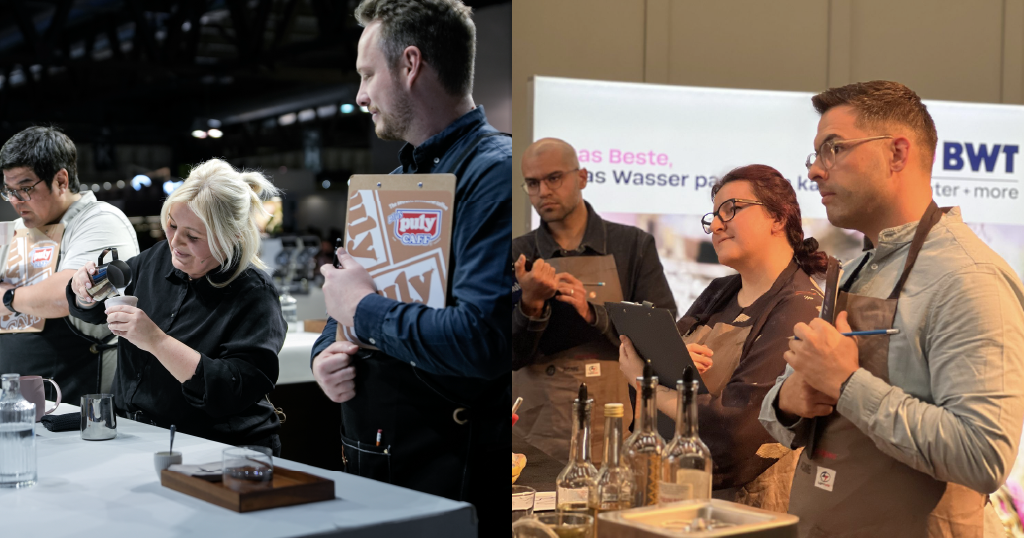
Competitions such as the WBC set the benchmark for attentive customer service. Baristas keep workstations immaculate, set music volume just right, and refill water glasses, all with a level of enthusiasm that reassures judges they’re in expert hands.
Competitors have 15 minutes to serve 12 drinks, explain their coffee in detail, and maintain composure throughout. The pressure is considerable, and how a barista manages it for the judges watching is itself a form of hospitality.
“Judges have to process an enormous amount of information in a short time,” Dominika says. “So I ask myself: is my language helping them understand more clearly, or distracting them? Are my instructions intuitive, or do they feel like homework? Am I guiding their attention, or demanding it?”
In her 2025 WBC routine, Dominika focused on three core values: authenticity, community, and communication. Gathering the judges around one table, she highlighted how small physical details, such as eye contact, pacing, and the use of silence, can elevate hospitality.
“Some of the strongest routines I’ve seen weren’t the most complex, but the most considered,” she adds.
Alica adopts a similar approach when coaching competitors. “Judges should understand what they are tasting and why it matters. This does not mean overwhelming them with information, but guiding them in a way that makes the experience coherent,” she says. “In a 15-minute routine, the workflow itself becomes part of hospitality. If the barista is calm and organised, judges can focus fully on the sensory experience.”

Hospitality behind the scenes
One aspect of hospitality that rarely makes it into coverage of the WBC is what happens off stage. Alica, who has spent considerable time at competitions as both a coach and a judge, says the backstage culture is frequently overlooked.
“Competitors often support each other, share tools, help solve problems, and calm each other down before stepping on stage,” she tells me. “There is competition, of course, but it’s rarely driven by ego. At its best, WBC is a place where people learn from each other and push the industry forward together.”
This, she argues, is hospitality in its broadest sense. “For me, hospitality is not only about how you treat the judges during your routine, but also how you treat the people around you.”
Cleanliness and workflow are also underappreciated aspects of café hospitality. A well-organised station, Dominika notes, communicates professionalism to a customer before a single word is spoken.
“A clean station tells the guest: ‘I’m in control.’ Many competitors design their stations so that cleaning is built into the workflow, not added on,” she tells me. “That’s directly transferable to service environments.”

Implementing competition-level hospitality in coffee shops
The question for most baristas is how to implement all these aspects into a busy shift. Both Dominika and Alica suggest the lesson is about intention.
“Hospitality is about doing things on purpose,” says Dominika. “World-class competitors don’t rush or overexplain, even when time is limited. Every interaction has clarity, and baristas can apply this by asking one simple question per shift: What experience am I trying to create right now?”
The trend towards attentive, meaningful customer service has always been present in specialty coffee, but it has noticeably grown in recent years. Brands like WatchHouse, which recently secured over £6m in funding to scale across the US and other global markets, embody intentional customer service. Baristas greet guests at the door, seat them, guide them through menus, and serve drinks tableside.
This transforms a casual café visit into a more curated dining experience. And with up to 78% of millennials stating they would rather spend money on memorable experiences than material goods, hospitality is one of the clearest value propositions in specialty coffee.
A key lesson to learn from competitions is the importance of preparation, Alica says. “Competitors repeat their routines many times until the technical elements become almost automatic,” she tells me. “Once that happens, they can focus more on communication rather than simply executing tasks.”
For coffee shops looking to elevate service, this means investing in barista training. Exceptional hospitality will only work if staff feel supported and engaged. But this is also set against a difficult financial backdrop. In recent years, operators worldwide have faced rising employment costs, persistent labour shortages, and mounting staff burnout, as higher wages, increased employer contributions, and heavier workloads have strained already thin margins.

For any barista looking to improve their hospitality skills, Alica offers a straightforward starting point: “Stay curious and stay humble. Hospitality is not about performing for the guest. It shows in small, consistent actions – how a drink is prepared, how a guest is greeted, how colleagues are treated.”
Enjoyed this? Then read our article on the future for customer service and hospitality in coffee.
Photo credits: Specialty Coffee Association, Fey Chen, Kevser Atmaca
Perfect Daily Grind
Want to read more articles like this? Sign up for our newsletter!
Source link