How technology is evolving for roasters
Estimated reading time: 7 minutes
Key takeaways
- Real-time data logging replaces manual note-taking, improving consistency and quality.
- Centralised data reduces waste and improves consistency when roasters scale.
- Modern technology is narrowing the gap between small and large roasting operations.
Roasting coffee has always required significant investment. The equipment, expertise, and tools needed to maintain consistency and quality have historically favoured more established operations, leaving many to rely on manual note-taking and instinct.
“Setting up a new roastery is a huge challenge. It involves financial investment, personal commitment, and quite a bit of stress to make it work,” says Thijs van Meurs, Senior Inside Sales Advisor at Cropster. “For a new business, any extra overhead is scary and risky, which is why a lot of roasters will often opt to track their data manually, but this comes with a lot of effort and time.”
But roasting technology has advanced considerably in recent years, and software is becoming more accessible to the businesses that need it most.
You may also like our article on how technology is evolving across the coffee supply chain.

Roasters often faced barriers to modern technology
Roasting software isn’t a strict requirement for producing great coffee, but its value to the industry is considerable. It has democratised the process, made the learning curve less steep, and automated much of the process – helping streamline operations when it’s never been more essential.
The main challenge, however, has been access to this software. For many smaller or younger roasters, often some of the most creative and innovative businesses, the cost of professional-grade tools has put them out of reach.
“In the past, high-level data logging and precision tools were often gatekept by expensive, industrial-scale machinery,” says Geun-jeong Park, the owner and head roaster at Q.roaster in South Korea. “As a micro-roaster, finding technology that offers the same level of granular control as large-scale systems, without the massive footprint or price tag, was a significant hurdle. We needed technology that could scale with us.”
Beyond cost, manual record-keeping has its own limitations; notes taken by hand are only as reliable as the people writing them. As a result, passing on information between roasters, refining profiles over time, and keeping inventory accurate all become harder to manage without a centralised system.
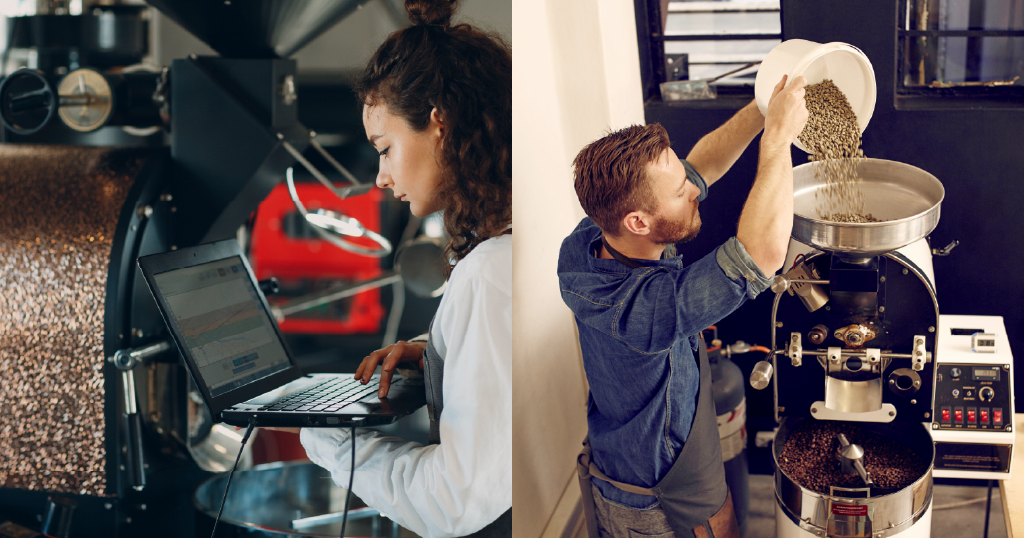
For roasters who transitioned to dedicated software, the practical benefits are tangible. Platforms like Cropster allow roasters to log roast profiles, monitor real-time data during a roast, manage green coffee inventory, track weight loss percentages, and replicate results across batches with a level of consistency that manual methods struggle to match.
“We use Cropster primarily for quality control and replicability. By using real-time data logging, we can overlay reference curves to ensure every batch hits the exact flavour profile we have designed,” says Geun-jeong Park. “It has turned gut feeling into quantifiable data, which allows us to troubleshoot roasts immediately and ensures our customers receive the same quality every time.”
How will roasting software continue to evolve?
Looking ahead, the next wave of roasting technology innovation needs to be defined by accessibility, not just performance. Smaller roasters need equal access to intuitive, smart technology that meets their specific needs, allowing them to maintain product consistency and solidify or grow their businesses.
In October 2025, Cropster acquired Firescope, a South Korean developer of innovative roasting software designed specifically for smaller roasting businesses. The move signals a broader shift: the technology that has helped large roasters refine their profiles, manage inventory, and replicate results with precision is now within reach of micro-roasters and start-ups.
More broadly, roasting software will become more comprehensive, encompassing all aspects of a coffee business. In line with this, Cropster has launched the coffee productivity platform that unlocks new data and reduces workflow complexity across the supply chain.
“Coffee is highly physical and sensorial, and its supply chains are notoriously fragmented,” says Christina Jakob, the Head of Marketing at Cropster. “Data is often trapped in manual spreadsheets, disconnected teams, or generic resource planning, which leads to double data entry, costly human errors, delayed decision-making, and significant margin leaks.
“Our new coffee productivity platform acts as a single digital system to connect teams, machines, and locations to reclaim this lost productivity,” she adds. “It’s built around five core solutions: Contracts & Costs, 360° Inventory Control, Roasting & Quality Control, Order Fulfilment, and Café Intelligence.”
By allowing roasteries to coordinate all resources in one place, the software can forecast needs based on real-time data and prevent last-minute purchases.


Roasters’ needs are now the focus of new software
The practical consequences of more accessible roasting software are that the analytical capability once reserved for large commercial operations is now available to anyone with a roasting machine.
“You no longer need a proprietary, high-cost built-in computer on a roaster to get world-class data,” says Geun-jeong Park. “By simply connecting a laptop, a micro-roaster can access the same analytical power as a global commercial operation. It has democratised precision roasting.”
Data gathered early, even on a small level, can significantly reduce waste when a roaster eventually scales up. Understanding how a particular coffee responds to different energy inputs, or what end temperatures produce the desired flavour profile, means that transitioning to a larger machine doesn’t require starting from scratch.
“Throughout our time servicing coffee roasteries, we’ve seen a bigger demand for roaster manufacturers to either implement their own tracking software or integrate with Cropster,” Thijs says. “The data we collect can further increase the knowledge of all coffee roasters.
“Roast profiles are easier to assess, accessing key data like RoR (rate of rise) readings, Roast Time Development percentage, soaking, and inlet temperature,” he adds. “Cupping data can also be shared with colleagues, business partners, customers, and other roasters.
“The amount of actionable data that people can collect and use within Cropster, like production reports, inventory reports, and quality comparisons, has helped many roasters improve their skills.”
Cropster’s acquisition of Firescope further extends its reach. Firescope developed a strong following among hobbyists and micro-scale roasters, offering a more accessible entry point than platforms designed for commercial production. Bringing the two together creates a pathway that can follow a roaster from their first experimental batches through to a fully operational business.
Supporting international roasters to scale
“With our merger, we will be able to help those same companies together,” says Jia Li Tan, Account Executive for APAC at Cropster. “It will help lower the barrier for entry for beginning roasters to start logging their data, so that when they inevitably grow, they can use what they have already collected to increase productivity.”
Firescope will be integrated into the broader Cropster portfolio, leading to a global launch. The merger will significantly expand Firescope’s global reach, empowering small roasters in Asia and beyond. “Together, we are now able to support a much broader spectrum of businesses, from micro-roasters and independent specialty cafés to large, multi-site roasting operations,” Jia says.
These efforts can now be scaled internationally. “The acquisition allows us to bring more resources to the coffee community in the Asia Pacific, which is one of the fastest-growing coffee markets in the world,” says Jia. According to Asia Business Outlook, demand for coffee has risen 6% year-on-year across the region, a rate about three times that of the rest of the world.
“We are now even closer to the coffee professionals in the region, to listen to their needs, and understand their businesses,” Jia adds. “Doing business in Asia is vastly different compared to Europe or the Americas.”

As the number of roasteries worldwide grows, demand for roasting software is rising, and the gap between what small and large operations can achieve is narrowing.
For roasters like Geun-jeong Park, the change is already visible: “It has levelled the playing field. The technology that was once out of reach is now part of how we work every day.”
Enjoyed this? Then read our article on why streamlining roastery operations has never been so important.
Perfect Daily Grind
Please note: Cropster is a sponsor of Perfect Daily Grind.
Want to read more articles like this? Sign up for our newsletter
Source link