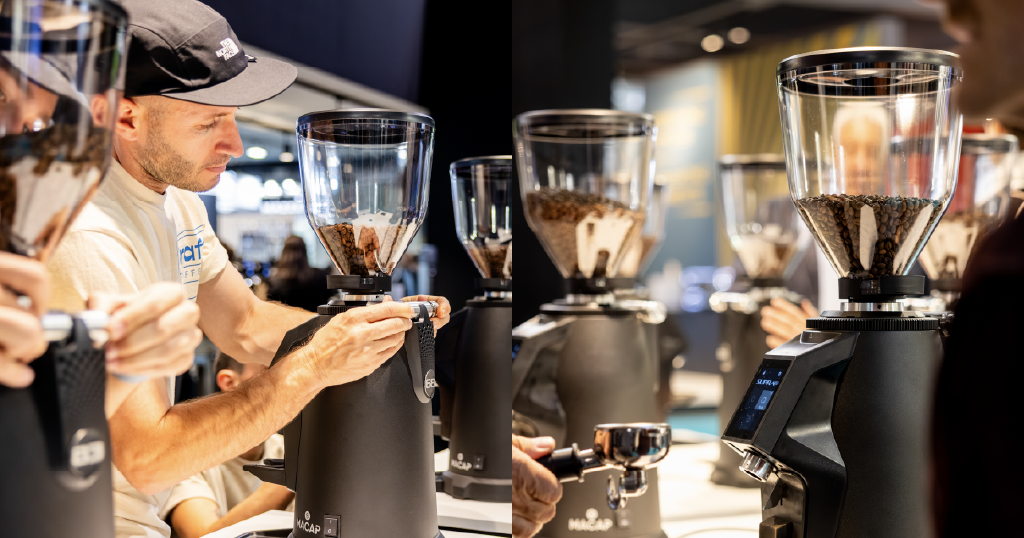
Coffee grinders are evolving, but what do baristas actually need from them?
Estimated reading time: 7 minutes
Key takeaways
- Grinder speed and accuracy are equally important for baristas.
- Grind-by-weight technology is now an industry standard rather than a premium feature.
- Baristas need equipment that supports their workflow, not complicates it.
- Accurate, quick dosing allows baristas to trust their grinders.
Coffee grinder technology has never been more sophisticated. From accurate gravimetric dosing to stepless micrometric adjustments and espresso machine sync systems, modern grinders offer baristas a level of precision and control not attainable until recent years.
In turn, skilled baristas can unlock a coffee’s full flavour potential – improving their technical knowledge, enhancing the consumer experience, and helping cafés secure loyal customers.
But as grinders become smarter, with more advanced features and interfaces, an important question emerges: Are they actually meeting baristas’ needs?
“The shift toward grind-by-weight is now well established. The real challenge lies in developing a system that delivers high precision without compromising speed or workflow efficiency,” says Denis Girardi, the Sales Director at Macap. “Beyond the essential requirements – robust performance, ease of use, and consistency – two parameters are critical: dosing speed and accuracy.”
Without both these factors, barista workflow is easily disrupted. If the grinder can’t keep pace with orders or produce accurate results, wait times increase, customer satisfaction drops, and coffee quality suffers.
As the demands placed on baristas increase, they need grinders that aren’t just smart and intuitive, but also fast, consistent, and reliable.
You may also like our article on the most valuable skills that every barista needs.

Even advanced grinders need to get the basics right
For most of specialty coffee’s history, espresso machines set the pace of equipment innovation. But over the last few years, grinders have caught up. Today, more feature touchscreens, pre-programmable grind settings, and connectivity that syncs with espresso machines – sharing key data and automatically adjusting grind size to meet recipe requirements.
Given that many consider grinders the most important piece of equipment, these technological advances are crucial for improving coffee quality. But for many baristas, the conversation around grinder technology circles back to the foundations of great workflow: speed, accuracy, reliability, and consistency.
“Our R&D efforts prioritise solutions that strike a balance between technological innovation and ease of use,” says Daniele Colizza, a R&D consultant who partners with Macap. “We introduce new technologies only when they offer a genuine advancement over established solutions, and most importantly, when they demonstrate superior performance and proven reliability in real operating conditions.”
Alongside a full website refresh, Macap recently launched its new Supra 68 G and Supra 83 G Series grinders, both of which integrate grind-by-weight capabilities that support workflow efficiency. Macap will showcase the grinders at stand G07 at the 2026 London Coffee Festival from 14 to 17 May.
Daniele explains that grinder technology needs to detect the smallest variations to ensure precise, accurate, and consistent results. “The Supra G can distinguish between portafilters within the same category, even when there are slight weight variations between them,” he says. “Our extremely fast and precise weighing system, combined with advanced software algorithms, makes this possible.”
Without this capability, baristas would need to manually check doses, particularly during a busy service when portafilters are swapped quickly, and small inconsistencies can quickly impede workflow.
Different coffee shops have different needs
Today, the diversity of coffee shops is huge, and each café operates within its own set of conditions. Water quality varies by location; staff turnover means changing barista skills; physical layout influences workflow; and the customer base brings its own expectations. All these factors directly shape how baristas work.
But for any coffee shop, speed of service is key. Research conducted by University College London found that the average customer is prepared to wait in line for 5 minutes and 54 seconds before considering leaving. The study also found that after waiting for five minutes, customer satisfaction can fall from 95% to 85%.
“The biggest benefit of Macap’s Supra G grinder is how quickly they tare the portafilter and dose coffee,” says Jon Townsend, Director and Certified AST Trainer at The Institute of Coffee. “You save two to three seconds per shot, which compounds into a significant amount of time saved over the course of an entire day.”
Cleanliness is also a major concern for any coffee shop, especially in high-traffic locations, where busy rushes can result in unclean, disorganised workstations.
“With the Supra G grinders, we optimised the trajectory and fall speed of the coffee grounds and the positioning of the portafilter on the fork with a centring Coffee Targeting System mechanism,” Daniele explains. “During setup, the user can precisely adjust the drop point to ensure that the ground coffee lands perfectly in the centre of the portafilter.
“Additionally, the integrated anti-clumping flapper prevents the formation of clumps and eliminates electrostatic effects, both of which contribute to a cleaner workspace,” he adds. “Baristas also have easy access to the grinding chamber through the Fast Opening System, making routine cleaning or replacement straightforward and efficient.”


Meeting coffee shops where they are at
Over the last decade or so, grind-by-weight systems have shifted from a premium differentiator to an industry expectation. But not all grinders are created equal, and what works in a low-volume specialty coffee shop may not be sufficient for a high-traffic chain in a busy location.
“For high-volume cafés serving 400 to 500 coffees a day, grinder features like consistency and accuracy are paramount,” Jon says. “You need that control to maintain a specific recipe within a tight timeframe.”
Denis explains Macap’s Supra G grinders are designed to maintain dosing accuracy across all coffee shop environments. “The interaction between motor power, burr size and material, and the design of the grinding chamber ensures that performance remains stable, allowing the grinder to maintain consistent dosing accuracy even under continuous, high-speed operation throughout the day.
“In many commercial grinders, dosing speed and weighing accuracy tend to be inversely proportional: increasing precision can slow down service, while prioritising speed can reduce accuracy,” he adds. “A well-implemented system is one that successfully balances these variables.”
Earning baristas’ trust
As grinders incorporate more high-tech features, they’re only as valuable as the baristas’ trust in them. One area where grinder technology has historically fallen short is scale accuracy, and the disruption to workflow and espresso consistency is significant.
“‘You get what you read’ means that once a target dose is set, the system transparently displays the actual measured weight within its tolerance range, without artificially rounding the value to match the programmed dose,” Denis explains. “This approach prioritises transparency over superficial precision, allowing baristas to fully trust the data they see.”
Speed is equally important. Technology that slows a barista’s workflow through sluggish interfaces, delayed feedback, or complex processes is essentially working against them.
“By speeding up the taring and dosing process with Macap Supra G grinders, you free up time to spend on tasks that benefit the coffee’s flavour and the overall customer experience,” Jon says. “It’s about creating a system where the equipment supports the person behind it.”

As grinder technology continues to evolve, the most meaningful features are those that serve the people using them, not just the spec sheet.
“We hope to see an increasingly pragmatic approach to coffee equipment, one that prioritises usability, efficiency, and tangible results in the cup over brand perception alone,” Denis concludes. “Ultimately, the goal is to make the barista’s work easier and more effective, regardless of the name on the machine.”
Enjoyed this? Then read our article on why more baristas are focusing on milk temperature.
Photo credits: Macap
Perfect Daily Grind
Please note: Macap is a sponsor of Perfect Daily Grind.
Want to read more articles like this? Sign up for our newsletter!
Source link