
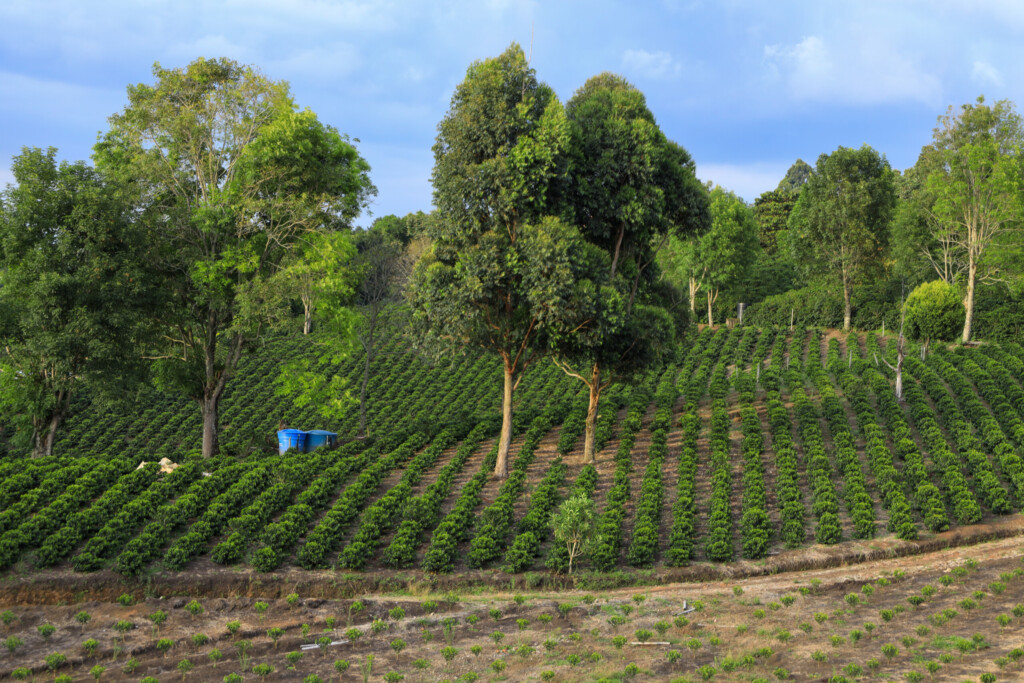
La Macarena farm in Cauca, Colombia, the origin of Frequent Coffee’s 94-point Wilton Benitez Red Bourbon Decaf.
Decaffeinated coffees are having their moment. The decaf coffee market is expanding rapidly, with projected growth of 5-7% annually over the next decade. Some estimates project the annual growth rate for decaf coffee will be up to four times that of the overall coffee market. At the 2024 US Brewers Cup finals held in Rancho Cucamonga, California, the winner placed first using a decaffeinated Typica from Finca Los Nogales in Colombia. When Coffee Review surveyed specialty roasters offering decaffeinated coffees for this report, we found three recently opened companies that only roast decaffeinated coffee.
Industry commentators cite a variety of reasons for the increased popularity of decaffeinated coffee. One of course, is the “wellness” trend, an intensified focus on sleeping better and feeling better — the same inclination that is said to be driving the recent decrease in alcohol consumption. Another is the customization culture of the much-analyzed Gen-Z, who are said to be more interested in coffee as another ingredient in sweet drink formulas than as a pretext for solemn single-origin connoisseurship.
But the reason for the increased popularity of decaf that interests us most is the claim that both the quality and diversity of decaffeinated coffees have improved over the last several years. This certainly made me, for one, happy. Not because I consume much decaffeinated coffee (an occasional espresso after dinner), but because I have always been put off by the “death before decaf” syndrome, the specialty coffee world’s tendency to patronize decafs and make snarky jokes about them. Rather than focusing on what’s missing in decaffeinated coffee, I prefer to focus on what’s still there, and how we can make it better.
A Sorry but Improving Record for Decafs
Over our history as a publication, we have carried out seven surveys of decaffeinated coffees intended for brewed applications. All ended with varying degrees of disappointment, though we have seen a slow, steady improvement over the years, as shown in the chart below:

But this is 2026, and now we’re hearing more and more good things about decaf. So, we scheduled this report and made a determined effort to solicit samples, particularly among innovative, smaller roasting companies.
The sheer volume of response was encouraging. We received 86 samples from 60 roasters. But that’s what happened in the mail room. What happened in the cupping room?
From a purely statistical point of view, our survey netted mixed results. The 86 samples we tested averaged 86.3. However, at the high end, our blind cupping uncovered a full dozen decafs that earned 90+ points, including a 94-pointer, our highest score ever for a decaf.
The Encouraging Top 12
But it’s not until we look at the character and identities of the 12 coffees that scored 90 or better that we see the most encouraging results for decaf consumers.
Because those 12 coffees were, every one, distinctive and vividly expressive. Not one was woody and lifeless, exhausted by decaffeination compounded by dealer and roaster complacency.
Furthermore, they offer to decaf drinkers a small but relatively complete sampling of some of the most typical and most important trends in specialty coffee today. Not one of the 12 was a blend, and all but one were traceable single origins, produced on specific farms and offered with detailed descriptions of processing and tree variety. (The You Betcha! Decaf Blend from Intuition Coffee Roasters (91) is a blend in name only, by the way; in fact, it is a classic washed single origin from an all-women’s cooperative in southern Colombia.)
Bag of 91-point You Betcha! Decaf on display at Intuition Coffee Company. Courtesy of Intuition Coffee Company.
On the other hand, if we look at the 12 top-rated decafs purely from the point of view of coffee geography, they are most certainly not varied. Nine of the 12 were produced in southern Colombia, two in Ethiopia and one in Burundi, south-central Africa. None at all originated in Central America or in the Asia-Pacific.
This limitation is, in part, a function of season. Southern Colombia and Burundi are both south of the equator and consequently harvest in our summer (their winter), so their coffees are in season now. Whereas Central America, Hawai’i and other familiar origins have northern hemisphere harvests clustered around the winter solstice. As I write, coffees from those regions (and from northern Colombia) are just beginning to work their way to traders and decaffeinators. True, our 12 report coffees included two excellent Ethiopias, which are northern-harvest coffees. Ethiopias tend to arrive almost all year round, however, and owing to tree variety and genetics, are usually aromatically intense and complete enough to stand up, not only to decaffeination, but to off-season roasting and presentation.
But if we consider the 12 top-rated decafs in terms of their potential to deliver to decaf drinkers the same range of opportunities for variety in other respects, from sensory pleasure to producer socioeconomics, the picture changes considerably.
Looking at Processing Method
For starters, outstanding examples of all significant processing methods are represented among these 12 decaffeinated samples, starting with classically balanced washed coffees from Blueprint (Decaf Huila, 92) and Intuition (You Betcha! Decaf Blend, 91). The four dried-in-the-fruit natural-processed coffees range from the savory-sweet, flower-forward Kakalove Colombia (93) to the deep-toned Ruby Ethiopia Guji Bento (92), the fresh and zesty Equator Ethiopia Suke Quto (91) and the cocoa-peach-inflected Torque Burundi (90). The honey-processed Dose Colombia (90) displayed the light-footed crispness associated with the hybrid honey method, influenced here by a discreet darker roast designed for espresso preparation.

Workers sorting coffee cherry on drying racks in Burundi. Courtesy of Torque Coffee.
The Anaerobic Thrillers
But what about the latest specialty thrill: crowd-pleasing, high-rated coffees processed by complex variations on anaerobic (sealed-tank) processing? Five impressive examples of this often brilliantly eccentric style of coffee are available as decaf and reviewed here, all at what appear to me to be reasonable prices. Three were roasted by recently launched companies that focus mainly or entirely on decaffeinated coffees: Frequent Coffee in San Diego (Red Bourbon Wilton Benitez, 94), Flower & Moon in Oakland (Hibiscus Dream Colombia Granja Paraiso, 93) and Heist in Orlando (Huila Colombia Pink Bourbon, 93). Two more fancy decaf anaerobics were roasted by Taiwanese companies: the startup Ailurophile (Cat Lover) Coffee Roastery (Granja Paraiso Red Bourbon, 93) and Dou Zhai Coffee (another Granja Paraiso Red Bourbon, 92).
Mark Gano roasting coffee at Frequent Coffee in San Diego, California. Courtesy of Frequent Coffee.
The Socioeconomic Angle
But what about decaf drinkers who care about honoring producers and supporting their livelihood? Again, all but one of the 12 top-rated decafs are traceable back to their producers, whether those producers are coffee celebrities like Wilton Benitez of Granja Paraiso-92 or Jhoann Vergara of Finca Las Flores, or cooperatives of smallholders like the OsoMujer women who gave us the Intuition coffee or the Tugwizikawa “Let Us Rise” cooperative in Burundi, source of the Torque Burundi Kirundu.
But Still …
Nevertheless, regular readers of Coffee Review may have noted that decaffeinated coffees generally appear to attract lower ratings than untreated coffees. How much lower on average? If someone asked our team to hazard a guess we probably would say decaf coffees generally tend to rate 2 to 3 points lower than comparable coffees that have not been decaffeinated.
However, the ratings for these 12 top-rated decaffeinated coffees appear to run only about one or two points lower than similar coffees that have not been decaffeinated. Not a dramatic difference, and certainly one difficult to confirm with hard statistics. Nevertheless, we gave it a try. We focused on the four coffees of the Red Bourbon variety grown and processed by Wilton Benitez and reviewed here as decafs. These four decaffeinated Red Bourbons averaged a rating of 93. When we pulled out ratings for three Wilton Benitez Red Bourbons processed by the same method but not decaffeinated, we netted an average of 94.3.
So this one very modestly scaled comparison suggests decaffeination only provoked a ratings reduction of a tad over one point. A better night’s sleep or less anxiety may well be worth it.
Returning to the Miracle of Fine Coffee
But we still might ask: Why does decaffeination reduce a coffee’s distinction and beauty at all?
I hope readers are already aware of how remorselessly challenging it is for the globe-straddling, complex coffee supply chain to create truly extraordinary coffees.
Suke Quto Farm in the Guji growing region of Ethiopia. Courtesy of Equator Coffees.
The growing elevation has to be right, the tree variety has to be right for the elevation, the weather needs to be obliging, and husbandry and picking both must be impeccable. Today, fruit removal and drying, AKA “processing,” have become complex expressive acts that aim to influence the sensory character of the bean, but even when those acts follow conventional expectations, they need to be performed faultlessly. Still more things can go wrong during shipment and storage. And assuming all of those previous acts were carried out to near perfection, the roaster still needs to source great beans, store them properly, and roast them tactfully. At which point the barista or consumer has to cap off the whole meticulous, months-long sequence of near-obsessive dedication by brewing well and serving fresh.
It amazes me how regularly great coffees beat the odds and end up in my cup with such extraordinary beauty and distinction.
But with decaffeinated coffees, we add one more fraught act to that already daunting chain of challenges. It comes in the middle of the supply chain, after the coffee is dried and cured, but before it goes to the roaster. At that moment, we aim to remove a single substance from the over 200 other substances in the unroasted bean that contribute to the sensory character of a green coffee, while leaving all of those other substances intact and untouched.
Impossible? So far in coffee history, I think it has been.
Decaf Coffee’s Moment
But as this report suggests, we can now come very close, and I think the 12 decaffeinated coffees reviewed here do come close. The coffees reviewed for this report appear to be sourced with care from green traders who care and roasted with sensitivity to the particular challenges posed by decaffeinated beans.
So, it appears that a decaf drinker with a smartphone or laptop can, for the first time in history, find a range of fine coffee options that parallel those enjoyed by the broader community of coffee drinkers. The number of these offerings may be small, but their variety and promise are impressive.
Source link