Key takeaways
- The Global Coffee Awards (GCA) recognise the world’s best roasteries and the producers who supply their coffees.
- Roasters from over 125 countries submitted more than 2,000 samples across all competitions in 2025.
- The GCA World Championship was held from 20 to 23 March 2026 before Producer & Roaster Forum in San Salvador, El Salvador.
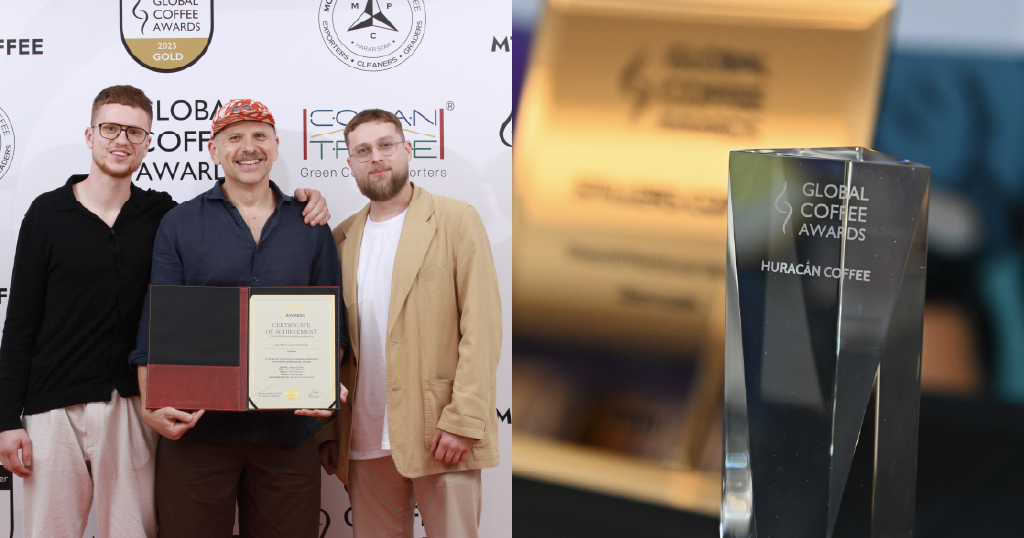
- The top three winners are Lithuania’s Huracán Coffee, Greece’s KAFEA Terra, and Colombia’s Café Cultor, earning the title of World’s Best Roasters.
- In 2026, the GCA will host regional MENA, Asia, Africa, the US & Canada, Latin America, Europe, and Origin Roasted competitions.
The Global Coffee Awards (GCA) World Championship took place from 20 to 23 March 2026 ahead of Producer & Roaster Forum (PRF) in El Salvador.
Throughout 2025, the GCA hosted competitions in the US & Canada, Europe, and Origin Roasted (any coffee-producing country) to recognise the best roasters in these regions and the producers behind their coffees.
More than 2,000 samples were submitted by roasters from over 125 countries, culminating in one of the most diverse and dynamic competitions in the coffee industry. The top 30 roasters from 16 different countries were exclusively invited to the World Championship, where they competed for international recognition and the title of World’s Best Roaster.
Lithuania’s Huracán Coffee was announced the overall winner, recognised for its exceptional coffees submitted in the Filter and Flat White Alternative categories.
This year, in response to surging interest from roasters around the world, the GCA will expand into the Middle East and North Africa (MENA), Asia, Africa, and Latin America to build on its explosive growth.
Read on to find out all the GCA World Championship winners and how you can take part in upcoming competitions.
Learn more about GCA here.

The Global Coffee Awards World Championship
Built around regional competitions, GCA invites roasters of all sizes, from small-batch independents to national brands, to submit their best coffees across defined categories.
The awards programme is designed to reward the company overall rather than an individual, helping roasters strengthen their branding and marketing.
“Selling excellent coffee requires a great team of people. It starts with the producer, then moves through sourcing, quality control, brand philosophy, and market research,” says Emi Rueda, the Project Manager at the Global Coffee Awards. “It’s a whole system, not just a single person.”
The GCA World Championship took place before PRF El Salvador, one of the coffee industry’s biggest and most important events. The World Championship was supported by Host and Equipment Partners Behmor and Technochef.
“Hosting the World Championship around PRF means roasters can network with world-leading producers and traders,” says Martin Suard, a Q grader and head of coffee at L’Arbre à Café in Paris, France. He was also the Head Judge at the GCA Europe and the World Championship.
The World Championship followed a format similar to the regional events. The Gold, Silver, and Bronze category winners from the US & Canada, Europe, and Origin Roasted categories submitted bags of roasted coffee for blind evaluation, maintaining the same rigorous judging standards and brewing protocols.
“It’s been so impressive to see how committed roasters were to taking part in the World Championship,” Emi notes.
All entries were awarded a numerical score across multiple criteria. “We added the Omni Roast category to the World Championship so roasters can have their coffees evaluated as both espresso and filter,” Emi explains. “This tests their versatility, technical skill, and ability to develop roast profiles that perform well across multiple brewing methods.”


On the evening of 26 March, the GCA Awards Ceremony and Annual Dinner took place at the Hilton Hotel in San Salvador. During this celebration, all winning roasters from the three regional competitions, the producers behind each winning coffee, and the newly crowned World Champions were formally announced, recognised, and awarded trophies.
Winning producers also received free tickets to the GCA Awards Ceremony & Annual Dinner, reaffirming GCA’s commitment to recognising the world’s best coffee producers.

Announcing the 2026 GCA World Championship winners
The winners of the GCA World Championship are:


Gold category winners:
- Filter – Huracán Coffee
- Espresso – KAFEA TERRA
- Flat White Dairy – Terres de Café in Paris, France
- Flat White Alternative – Huracán Coffee
- Omni Roast – Café Cultor
For subcategories, entrants who received identical numerical scores both placed first to ensure fairness and parity.
Gold winners of each sub-category (roaster and producer):
Filter:
- Blend – White Peach Club, Huracán Coffee & multiple producers
- Single origin traditional – Sarchimor, Huracán Coffee & Edzon Jesus Meza Lopez at Finca Del Alba, Mexico
- Single origin experimental
- Pink Bourbon, Casa Landino in Bogotá, Colombia & Albeirson Prada Devia at Finca Tres Esquinas, Colombia
- Area51 COL Ombligon, KAFEA TERRA & Manuel Lopez Cardenas at SIGILO, Colombia
- TyOxy Typica Mejorado, Terres de Café & Pepe Jijón at Finca Soledad, Ecuador
- Washed – Crown Gesha, Café Cultor (producer undisclosed)
- Natural – Xilontla Gesha, Huracán Coffee & Carlos Alberto Cadena Pale at Finca Xilontla, Mexico
- Honey – Typica Mejorado, Cabra Negra Coffee Roasters in Quito, Ecuador & Mario Hervas at Finca Meridiano, Ecuador
- Experimental – Monteblanco Mango Biche Purole Caturra, Vero Coffee House in Kaunas, Lithuania & Rodrigo Sanchez at Aromas Del Sur, Colombia
- Decaf – Las Flores Pink Bourbon, Vero Coffee House & Jhohan Vergara and Nestor Lasso at El Diviso, Colombia

Espresso:
- Blend – Regina (blend of Heirloom, Yellow Catucai, Castillo, Caturra & Colombia varieties), Stamp Act Coffee in Seattle, Washington, US & multiple producers (Kayon Mountain in Guji, Ethiopia; Fazenda Cruzeiro in Cerrado Mineiro, Brazil; Friends of Tolima in Tolima, Colombia)
- Single origin traditional – Don Andres Parainema, Vero Coffee House & José Nahun and Fernandez Sabillon at Las Flores, Honduras
- Single origin experimental – Area51 COL SL28, KAFEA TERRA & Wilton Benitez at La Macarena, Colombia
- Decaf – Huila Sereno Pink Bourbon, Audun Coffee in Bydgoszcz, Poland & nine producers in Colombia (Diego Javier Trujillo Apache at Las Delicias; Elkin Ramírez at El Mesón; Willinton Hoyos at El Encanto; Fredy Palomino Parra at El Jardín; Cesar Calles at Los Ángeles; Hernan Florez at La Granja; Rolando Guerrero at Nataima; Derly Herrera at La Siberia; Camilo Andrés Cupitre Aldana at Pomerania)

Flat White Dairy:
- Blend – 3 Reinas Caturra Sarchimor, Café de las Nubes in Alvarado, Mexico & Graciela Cuevas Panzzi at Tierra de Reinas, Mexico
- Single origin – Chiroso, Terres de Café & Hunter Tedman at Black Moon Farm, Panama
Flat White Alternative:
- Blend – The Gentleman, Huracán Coffee & multiple producers
- Single origin – Xilontla Gesha, Huracán Coffee & Carlos Alberto Cadena Pale
Omni Roast:
- Blend – 3 Reinas Caturra Sarchimor, Café de las Nubes & Graciela Cuevas Panzzi
- Single origin – washed Gesha Eclipse Universal, Café Cultor (producer undisclosed)

A global snapshot of the coffee market
In addition to the regional events, the GCA World Championship provided insight into a broad range of specialty coffee markets across the world.
“It’s the culmination of the global journey we’ve seen across the 2025 regional editions,” Emi explains. “The results allow us to see how roasters from different continents and regions, whose customers have different interests, palates, and expectations, compare with one another.
“It gives us unique, specific insight into how people across the world drink coffee – a valuable resource for any roaster and producer.”
The World Championship showcased a diverse range of processing methods. These included traditional washed, natural, and honey lots, as well as more experimental techniques such as anaerobic fermentation, co-fermentation, and TyOxidator. Exclusive varieties, such as Ombligon, Typica Mejorado, Sidra and Pink Bourbon, which are often seen at other high-end competitions, were also submitted.
Filter was the most popular category, demonstrating the drink’s global popularity.
“We can clearly see the differences between the European, US, Canadian, and origin markets – the coffees they’re sourcing and the producers they’re working with,” Martin explains. “With this information, everyone becomes much more knowledgeable about the global coffee industry.”
The highest-scoring coffee was Vero Coffee House’s Don Andres Parainema in the Single Origin Traditional Espresso subcategory, scoring 9.06 out of 10. “I first purchased this coffee, which has tasting notes of blackberry, blackcurrant, and chocolate, at the 2023 Cup of Excellence Honduras auction, where it placed fourth,” says Darius Vėželis, the CEO of Vero Coffee House. “I then met José in person at PRF Honduras in 2025.”
Huracán Coffee also won in the Filter and Flat White Alternative categories using coffee from Carlos Alberto Cadena Pale, which placed fifth at the 2025 CoE Mexico competition.

What makes the Global Coffee Awards so important?
The GCA focuses on roasted coffee rather than green beans, providing a comprehensive quality assessment that encompasses a wide range of coffee appealing to diverse consumer preferences.
“Roasters gain international visibility and media coverage, and their coffees are highlighted in a way that also celebrates the producers,” Martin explains.
Alongside rewarding the world’s best roasters, the GCA recognises the producers who grow the winning coffees. “Through this, we strengthen the relationships between roasters and producers and help facilitate more constructive dialogue,” Emi explains. “This helps producers grow coffee with a target market in mind and allows roasters to better understand how to sell more coffee.”
An objective and transparent scoring system is used for every entrant across all categories to provide actionable feedback. “As an industry, we rarely think about how the end consumer experiences coffee,” Emi explains. “Many roasters were grateful for the detailed feedback, allowing them to improve the customer experience and strengthen their revenue.”
The coffees in each category are prepared as a consumer would experience them in a café, using specific brew ratios and brewing protocols. This real-world assessment ensures that coffees are judged as accurately as possible.

“Every roaster gets feedback on the way they interpret and roast their coffees. It allows them to have a much more in-depth analysis of their roasting styles,” Martin explains. “We use the exact same recipes and preparation guidelines, so it’s more about the coffee itself than the final cup. It’s geared towards marketing: the roaster can sell the coffee for what it is, rather than what they expect it will be.”
Each coffee is evaluated through a two-stage blind tasting: judges first conduct a two-minute quantitative sensory assessment to score and describe the coffee, followed by a three-minute discussion led by a coordinator to refine and align qualitative feedback. All comments are intended to be constructive and encouraging, offering clear insight without unnecessary technical detail.
“The judging process ensures everyone is calibrated to assess the coffees, but the judging panel is made up of people from different countries, giving the roaster fresh insight,” says Martin.
For a coffee in the Filter Experimental Category at the GCA Europe edition, for example, the judges recommended continued experimentation with roast development or rest time to amplify vibrant fruit notes without compromising the coffee’s balance.

Announcing the 2026 GCA schedule
Following its success in 2025, the GCA will expand into new regions this year.
Judging for the MENA, Africa, and Asia editions was originally scheduled to take place at Cypher Roastery in Dubai, UAE. Given the current conflict in the Middle East, the MENA, Africa, and Asia editions will now take place in the US. The full 2026 GCA schedule includes:
- MENA (Middle East and North Africa): 15 June 2026. Judging will take place at Balzac Brothers in Charleston, South Carolina, US
- Africa (excluding MENA countries): 16 June 2026 at Balzac Brothers
- Asia (excluding MENA countries): 17 June 2026 at Balzac Brothers
- US & Canada: 10 August 2026. Judging will take place at Copan Trade in Tomball, Texas, US
- Latin America: 12 August 2026 at Copan Trade
- Europe: 12 October 2026. Judging will take place at Belco in Bordeaux, France
For the 2027 edition, GCA aims to expand into Oceania for full international coverage.
“We’re a global competition, so we want to include roasters from every region,” Emi says. “Last year, there was strong interest from outside the US & Canada, Europe, and Origin Roasted countries. Roasters from countries such as Argentina, Japan, Chile, and Taiwan wanted to compete, so we’re giving these roasters an opportunity for global exposure, too.
“This is also why we created separate categories for different coffee-producing countries, like Asia, Africa, and Latin America,” Emi adds. “We give roasters from these regions who aren’t based in coffee-growing countries the chance to compete.”
For roasters based in coffee-producing countries, there will be a separate Origin Roasted category in the MENA, Asia, Africa, and Latin America competitions. This means that if a roastery is located in a producing country and they submit a coffee grown in their home nation, they receive an automatic, free-of-charge entry into the Origin Roasted category.
“Effectively, they double their chances to compete,” Emi explains. “This dual-category system ensures we spotlight roasters in producing regions, often less recognised on an international level, who are supporting and representing their country’s coffee sector.”
In line with judging and roaster feedback, there will be new categories and subcategories at the 2026 GCA events. These include:
New categories
- Specialty Drip Bag – Blend, Single Origin, Experimental, Decaf
- Capsules (Nespresso compatible) – Blend, Single Origin, Experimental, Decaf
- Ready To Drink (RTD) – Blend, Single Origin, Signature, Dairy Latte, Plant-Based Latte
New subcategories
- Espresso – Experimental Blend and Classic Roast Profile
- Filter – Experimental Blend, Classic Roast Profile, Liberica, Gesha, Co-Fermented, and Barrel Aged
- Flat White Dairy and Flat White Plant-Based Milk (renamed for clarity) – Experimental and Classic Roast Profile
“The new categories and subcategories are based on what we’re seeing in the coffee market,” says Emi. “There has been a boom in experimental processing, for instance, and more young people around the world are drinking RTD coffee.”
Category availability will be determined based on regional participation levels, market relevance, and product popularity. This ensures that each competition reflects the realities of its local and regional market while maintaining global consistency in judging standards.

How can I apply to the GCA?
Roasters of any size can compete in the GCA. After selecting an entry package, applicants must select the categories and subcategories in which they wish to compete, as well as the number of coffees they want to submit.
All coffees submitted for the GCA MENA, Asia, and Africa editions must be received by 1 June 2026. The entry kits, which include judging forms, are available below:
The winning regional roasters will be exclusively invited to compete in the 2027 GCA World Championships, to be held at PRF 2027, with a location to be confirmed in the coming months. This will include the GCA Awards Ceremony and Annual Dinner, giving roasters and producers the opportunity to network with industry leaders and experts.

The 2026 GCA will be the biggest edition yet, including more roasters than ever from around the world.
Through its international competition circuit, the GCA is designed to find not only the best roasters across different regions but also to place them against each other, culminating in a global champion.
Contact info@globalcoffeeawards.com and Emi Rueda via WhatsApp here for more information.
Learn more about PRF here.
Photo credits: Global Coffee Awards
Perfect Daily Grind
Want to read more articles like this? Sign up for our newsletter!
Source link