
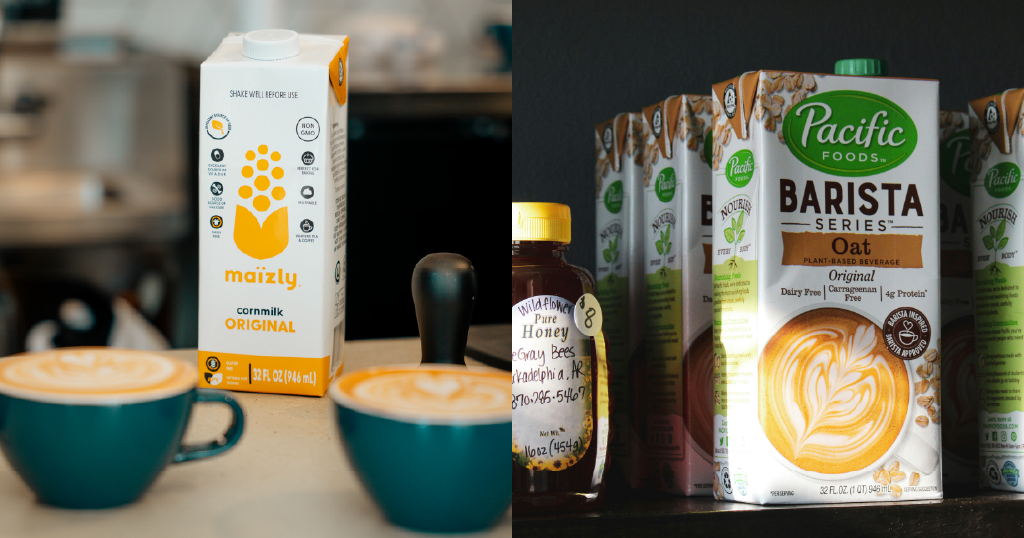
- Campaigns by PETA and Free4DairyFree allege that coffee shops “tax” consumers who order plant milks.
- Starbucks, Dunkin’, Pret A Manger, Dutch Bros, Scooter’s Coffee, and Gail’s have all discontinued their alt milk surcharges.
- Plant milks cost significantly more, squeezing independent cafés’ tight margins while large chains can absorb the difference.
- Specialty coffee shops must carefully balance consumer expectations with financial sustainability.
For over a decade, many coffee shops applied a modest surcharge for plant milks. The rationale was simple: oat, almond, soy, and coconut milks cost more than dairy.
In the UK, for instance, plant-based options retail at around £1.92 per litre, versus £1.24 for cow’s milk – a 55% price difference that is difficult for many independent coffee shops to cover.
But as plant milks have become more mainstream, consumer resistance to surcharges has grown. In response, major chains have begun removing them: Peet’s Coffee dropped its US 80 cent upcharge in mid-2025, while Blue Bottle and Stumptown have even made oat milk the default in some US stores.
These moves are reshaping consumer expectations and increasing pressure on independent cafés to follow suit. However, without economies of scale, many small specialty coffee shops can’t easily absorb the added cost, raising questions about whether eliminating plant-milk surcharges is a realistic or fair expectation.
Richard Agudelo of Terremoto Coffee, Alexandru Niculae of Bob Coffee Lab, Will Douglas of Loveless Coffees, and Tim Leclercq of Maïzly share their perspectives.
You may also like our article on whether defaulting to oat milk paid off for coffee shops.

The rise of plant milks in coffee
Plant milks, particularly oat, have become a fixture on coffee shop menus over the past decade.
“There are many reasons for the growing popularity of plant milks, but the three we hear most often are: first, people with allergies or intolerances who want to avoid dairy,” says Tim, the co-founder and CEO of corn milk brand Maïzly. “Second, those looking for a healthier alternative, concerned about dairy’s high sugar content and the possibility of traces of antibiotics or steroids used in cows, or whose dietary preferences lean toward flexitarian or vegan.
“And third, sustainability: dairy has a much larger environmental footprint than plant-based milks,” he adds. “In Maïzly’s case, this is especially true for water and land use, as corn requires less land and water per unit of produce than any other above-ground crop.”
According to World Coffee Portal data, more than 28% of customers at UK-branded coffee chains now choose oat milk, making it the country’s most popular non-dairy option.
Early adoption was driven by a combination of dietary needs, lifestyle choices, and taste preferences. Many consumers were initially willing to pay a premium, particularly because oat milk most closely replicates the texture and mouthfeel of dairy.
There was also broad acceptance that plant-based milks cost more to produce, require additional ingredients and specialised processing to perform well when steamed, and lack the economies of scale and subsidies that support the dairy industry.
The backlash against surcharges
More recently, however, sentiment has begun to shift. An estimated 65% of the global population is lactose intolerant, prompting growing scrutiny of surcharges that disproportionately affect those unable to consume dairy.
“The cost of living has risen substantially since Covid-19, which creates the push back on prices, but also the view that plant-based milks are the new standard and no longer a luxury,” Tim adds. “So the extra charge is starting to feel unfair.”
Advocacy campaigns led by organisations such as PETA and Veganuary have also framed surcharges as inequitable, intensifying pressure on coffee shops to reconsider their pricing strategies.


The case for charging more for plant milks
Although the argument against upcharging for plant milk is valid, the case for such surcharges is equally compelling.
By far the most prominent reason is the higher costs of manufacturing plant milks.
“Eight ounces of dairy costs us roughly US 21 cents; the same amount of oat or almond milk costs 85 cents,” says Will, the co-owner of Loveless Coffees in Brooklyn, New York City, US.
Barista-formulated versions are especially costly. Ingredients added to replicate the fat and protein contents of dairy milk will increase manufacturing costs. But without them, pouring crisp, high-contrast latte art would be impossible even for the most skilled baristas.
Although some coffee shops have explored ways to offset the additional cost, such as producing in-house plant milks or adding extra soy lecithin to commercial milks, a surcharge is often the most viable option to achieve consistent results.
“Plant milks simply cost us more, so there’s a small extra charge to keep things fair and consistent,” says Alexandru, the co-owner of Bob Coffee Lab in Bucharest, Romania. He is also the 2016 World Coffee Roasting Champion and a multi-time Romanian Brewers Cup Champion. “Big chains can absorb the hit, but we don’t have that scale.”
Big vs small
In addition to major players such as Starbucks, Costa, Peet’s, Dunkin’, and Pret A Manger, more established specialty coffee brands like Stumptown and Blue Bottle have been able to drop their surcharges. Notably, both roasters were acquired by multinationals in the 2010s, increasing their ability to absorb costs.
Smaller, independent operators, meanwhile, don’t benefit from large-scale centralised sourcing and high-volume orders, thereby inhibiting their ability to remove plant milk upcharges without affecting margins. Therefore, they must tread more carefully.
“Non-dairy milks are double the price of dairy; we simply have to account for that,” says Richard, the founder of Terremoto Coffee in Manhattan, New York, US. “We can’t absorb the price into our bottom line, more so in this current marketplace.”

So what’s the solution for specialty coffee shops?
As plant-based milks move from optional add-ons to expected menu staples, independent coffee shop operators are increasingly confronted with a fundamental question: who absorbs the cost of this transition?
For many, the answer begins with financial literacy and a clear understanding of operational efficiency. Some cafés may remove surcharges if they have sufficient margin headroom, viewing it as a competitive lever as more chains eliminate plant-milk upcharges.
“You have to look at your costs and decide if you’re there to offer a quality product or just churn and burn,” Richard says. “If you can manage to absorb the cost, that is a bottom-line business decision.”
Others see surcharges as a necessary and largely accepted reality. “Luckily, since we opened, we have always had a markup for non-dairy milks,” Richard adds. “Only one customer has complained in our ten years in business.”
For many specialty cafés, limited storage capacity, perishable inventory, and tight margins necessitate frequent deliveries and careful stock management to minimise waste. In this context, surcharges function as a cost-recovery mechanism, helping operators maintain beverage quality while aligning pricing with operational realities.
Pricing strategies can also vary by beverage type. “We charge US 50 cents for plant-based milks in espresso drinks, but not when adding to drip coffee or cold brew,” Will says, noting that the approach has met little resistance from customers.
Less is more
Still, as consumer expectations evolve, operators that retain surcharges risk being undercut by competitors that don’t. Transparency, therefore, plays a critical role in maintaining trust. “We explain that we use premium plant milks and locally sourced dairy, and that pricing reflects real costs, not arbitrary fees,” Alexandru explains.
For some, simplification offers a path forward. Limiting menus to one or two well-performing plant milks can help control costs without compromising choice. “Alt milks push us creatively and help diversify the menu beyond our core dairy-based drinks,” Alexandru adds. “But you don’t need ten different types – just one or two that fit your brand identity.”

Plant-milk surcharges are rapidly disappearing from coffee chains, signalling how mainstream non-dairy options have become. For independent specialty cafés, however, the decision is far from simple.
Charging extra risks alienating customers who now expect plant milks as standard, yet removing the fee can strain already tight margins. With higher input costs still a reality, independent cafés must strike a careful balance between meeting consumer expectations and protecting their bottom line.
Those who do so with financial discipline and clear communication are most likely to succeed.
Enjoyed this? Then read our article on whether dairy is making a comeback in specialty coffee.
Photo credits: Terremoto Coffee, ,Maïzly
Perfect Daily Grind
Want to read more articles like this? Sign up for our newsletter!
Source link