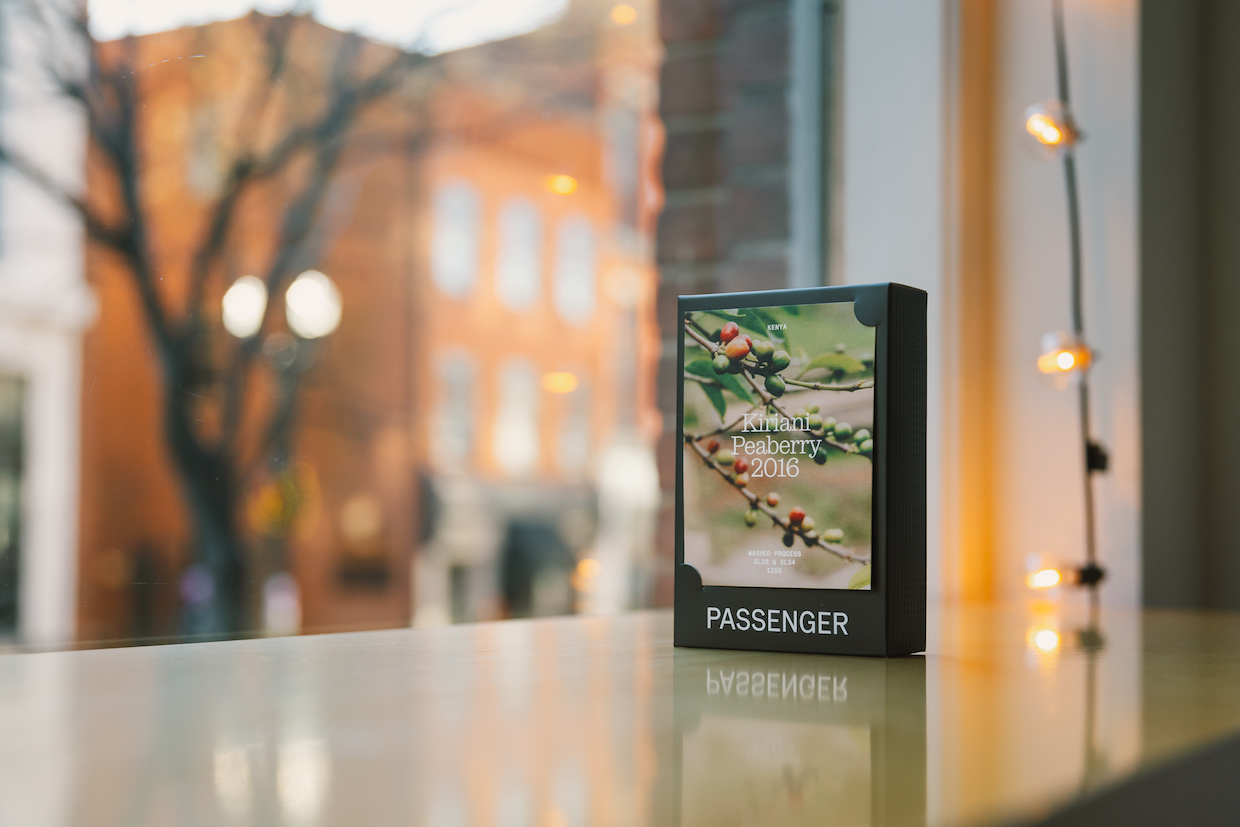
In a move that challenges both quality control and marketing norms in specialty coffee, Pennsylvania-based roaster Passenger Coffee is releasing a high-end coffee harvested 10 years ago.
The company described this week’s release of a Kenya Kiriani Peaberry from the 2016 harvest — frozen as green coffee at peak freshness — as “proof of concept” for its long-term green coffee freezing program.
The 10-year mark represents something of a milestone in specialty coffee, where roasters such as George Howell Coffee and Proud Mary Coffee have used freezing (a.k.a. cryogenics) to maintain freshness, then offer coffees from past years’ crops — a move reminiscent of the wine world’s “vintages.”
Passenger Coffee has been experimenting with freezing greens since 2014, expanding the program to all coffees in 2017 with a storage facility in Lancaster. The company currently roasts about 5,000 to 6,000 pounds of coffee per week, all of which emerges from a frozen state.

Passenger Coffee representatives checking frozen-stored coffees. Passenger Coffee courtesy photo.
“Green coffee preservation in the freezer has been integral to Passenger’s sourcing program and strategic planning since day one, and it continues to inform inventory management and menu curation in significant ways,” Passenger director of coffee Russ Durfee and green buyer Evan Howe jointly said in a statement to Daily Coffee News. “With the benefit of the freezer, we eliminate the risk of our green coffees beginning to show past-crop qualities before we’ve roasted through them.”
This strategy allows Passenger to present what it calls “Archival” releases — standout coffees preserved for later limited-release offerings — as well as “Foundational” coffees from a well-established network of producer partners.
Durfee and Howe suggested the freezing program benefits customers by maintaining peak quality for year-round offerings, while also benefiting producers, since the company can commit to more coffee from each harvest, “rather than the much smaller volumes we could commit to if we had concerns about green coffee shelf-life.”
According to the Passenger team, the freezing program carries significant costs associated with additional frozen storage, inventory management and transportation. Responding to a DCN question regarding the program’s environmental impact, Durfee and Howe said that from “a purely environmental angle, there is no way around the fact that freezing coffee for extended periods of time is not optimal.”

Passenger Coffee courtesy photo.
Yet they said they believe the program has broader potential benefits. “At Passenger we’ve often tried to consider sustainability from an additional angle, which is, ‘what does it look like for a coffee roaster to pursue practices that contribute to a more economically sustainable business model for coffee producers?’” they said.
As for the time-capsule coffee being released this week, Passenger described the peaberry coffee from Kiriani Estate in Kenya as having jammy blackcurrant sweetness with vibrant citrus tones that have fully held up over a decade.
‘This lot is not only one of the longest-preserved coffees remaining in our archive but also one of the finest examples of the efficacy of green coffee preservation that we’ve tasted to date,” Durfee said in an announcement of the release.
Comments? Questions? News to share? Contact DCN’s editors here. For all the latest coffee industry news, subscribe to the DCN newsletter.
Related Posts
Nick Brown
Nick Brown is the editor of Daily Coffee News by Roast Magazine.



Source link