
Welcome to Design Details, an ongoing editorial feature in Daily Coffee News focused on individual examples of coffee shop architecture, interior design, packaging design or branding. If you are a coffee shop owner, designer or architect and would like to submit your project for consideration, reach our editors here.
Design Details: Early Yuyen
- Project: Early Yuyen (Instagram)
- Location: Bangkok, Thailand (at My Paws Backyard Dog Park)
- Interior Architect: Spacecraft Co., Ltd. (spacecraftbkk.com)
- Circular Strategies Development: Natchai Suwannapruk, Kaytita Chaisuksiri
- Area: 65 square meters (699 square feet)
- Completed: 2024
- Photographer: Panoramic Studio
- Furniture Design: AThing

The second location of the high-end coffee retail concept Early BKK in Bangkok, Thailand, addressed a simple but ambitious question: “How far can circular strategies be implemented in a new cafe?”
Coming two years after the launch of the initial location, the new Early Yuyen at My Paws Backyard Dog Park employs a holistic approach to resource reuse and recycling, while extending the brand’s focus to include more families and pet lovers.
The Bangkok design firm Spacecraft set the framework for the new cafe in a workshop guided by the Ellen MacArthur Foundation’s “Butterfly Diagram,” a process that emphasizes the “four Rs” of circularity — reduce, reuse, recycle and recover — and designs toward disassembly to maximize material lifespans.

Reduction and reuse were aided by the existing site, a former canteen. “A decision was made to maintain the structural components while salvaging furniture for reuse in the new cafe,” Spacecraft said in a project description shared with DCN. “Surfaces were deconstructed and sorted, with aluminum profiles sold for recycling and part of the floor tiles saved for future use in the design.”
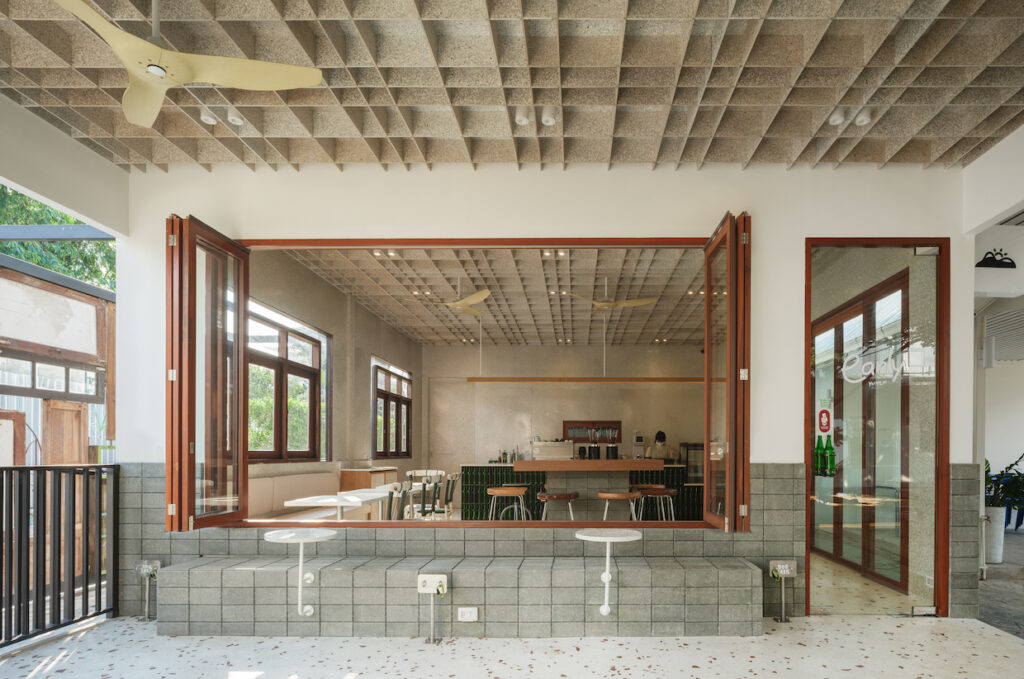
The cafe’s design extends to the gate of a popular neighborhood dog park, incorporating reclaimed windows and door frames arranged in an interlocking pattern and giving a second life to materials to create a literal threshold to welcome guests.
Inside, design followed a spirit of living comfortably, promoting daylight and open air. “The airy interior space benefits from shade cast by tall trees, offering a semi-outdoor experience when temperatures permit,” Spacecraft said.

Salvaged glazing from a reclaimed warehouse drives the facade concept, with a large operable window providing natural ventilation to the interior and framing the cafe for people outside.
The concepts of recycling and designing for disassembly come through most clearly at the bar, where decorative elements come from repurposed glass, including glass shards worked into the terrazzo countertops. A recycled milk-carton material called Reboard was used for standalone partitions and a modular waffle ceiling, with fasteners allowing for easy disassembly.

In collaboration with AThing, “the existing canteen chairs were remodeled with used clothes and canvases to renew their appearance.” New movable benches “made from recycled plastic caps” add flexibility to the semi-outdoor zone. Outside, the shop features a fully recycled shredded-plastic building material called Ecobrick.
“Though not yet fully circular, we are taking an ‘early’ step in pushing boundaries to explore and incorporate circular strategies in practice,” Spacecraft said. “This initiative sets an example of how collaboration and a holistic approach can drive meaningful progress toward sustainable development.”


Comments? Questions? News to share? Contact DCN’s editors here. For all the latest coffee industry news, subscribe to the DCN newsletter.
Related Posts

Source link