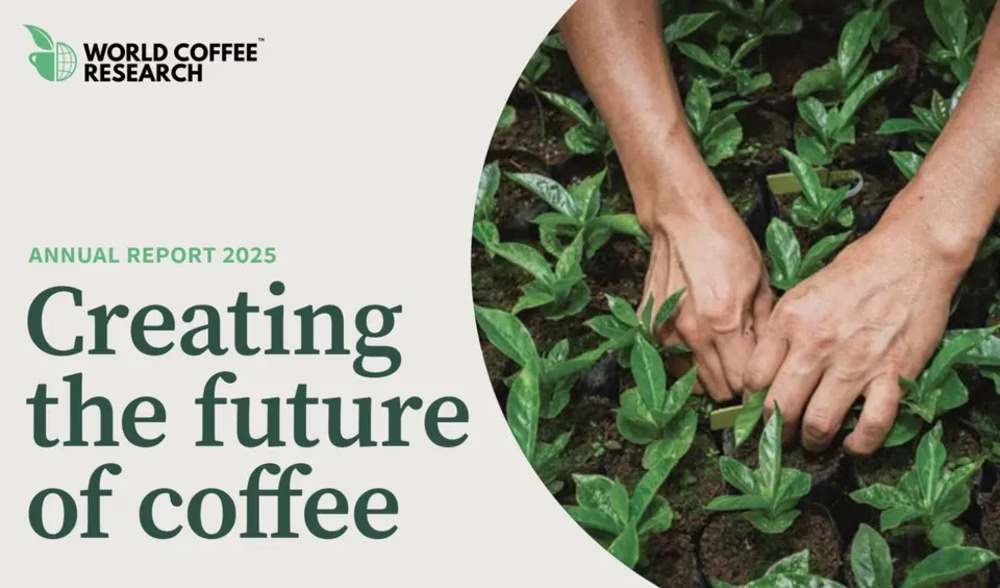
Dedicated to securing diverse and sustainable supplies of coffee throughout the future, the agricultural research organization shares their 2025 findings and accomplishments.
BY BHAVI PATEL
BARISTA MAGAZINE ONLINE
Featured image courtesy of World Coffee Research
What to know:
- World Coffee Research’s Innovea Global Breeding Network made significant progress in 2025, expanding to include robusta breeding for the first time and adding Vietnam and Ghana as national partners, with 11 partner countries now collaborating to produce 40% of the world’s coffee supply.
- The organization has achieved a radical leap in breeding science, developing low-cost genetic markers for coffee leaf rust and aiming to reduce the traditional 30-year breeding timeline to just 8 years, with the goal of bringing better trees to farmers’ fields.
- WCR’s efforts are translating to tangible results on farms, with new seed lots and mother gardens established in countries like Peru and Uganda, and advocacy efforts securing $175 million in US federal funding for international agricultural research and development, including coffee research.
The coffee industry is facing a reckoning. Global warming is reshaping growing regions, disease pressure is intensifying, and the varieties farmers have relied on for generations may not carry us through the next few decades. Nonprofit agricultural research organization World Coffee Research (WCR) has just released its 2025 Annual Report, and the findings paint a picture of both urgency and extraordinary scientific momentum. For anyone invested in the future of specialty coffee, this report is essential reading.

The Innovea Network is now a global force
At the heart of WCR’s work is the Innovea Global Breeding Network, named a TIME best invention of 2025: a distinction that signals just how far coffee science has come. The report describes Innovea as “the most ambitious and globally coordinated coffee breeding program in history,” and the numbers back that up. Eleven partner countries, which ordinarily compete with one another in export markets, are collaborating within a single shared breeding system, collectively producing 40% of the world’s coffee supply.
In 2025, the network expanded to include robusta breeding for the first time, adding Vietnam and Ghana as national partners. Six countries are now part of the robusta effort, together accounting for 64% of global robusta production. Arabica trial sites were simultaneously installed across seven countries, including Costa Rica, Kenya, Rwanda, and Peru. Elite genetics are now in research fields on four continents.

A radical leap in breeding science
WCR commissioned an independent panel of global breeding experts in early 2025 to evaluate its programs. Their verdict was unambiguous. The panel concluded that WCR’s initiatives represent “very significant (radical) changes in the breeding of the world’s two most important coffee species,” moving the industry into an era of “data-driven and demand-led breeding . . . to maximize genetic gains in yield, disease resistance and quality traits.”
One of the most consequential advances underway is the development of low-cost genetic markers for Hemileia vastatrix, or coffee leaf rust—the world’s most economically devastating coffee disease—through a new collaboration with Cenicafé and the USDA Tropical Agricultural Research Station in Puerto Rico. These tools are designed to shrink the traditional 30-year breeding timeline down to just 8 years.

Getting trees into farmers’ fields
Scientific breakthroughs mean nothing if they don’t reach farms. WCR’s seed systems program is addressing this directly. In Peru, 10 new arabica seed lots are now operational across eight cooperatives, with a production potential of up to 6 million seeds per year by 2028—enough to renovate 1,500 hectares annually. In Uganda, 11 new mother gardens for disease-resistant robusta have been installed, with projections to produce over 560,000 high-quality trees per year by 2028. Pre-commercial F1 hybrid trials are now live in Peru, Guatemala, and Costa Rica, with 10,000 plantlets in farmers’ fields across 10 trial sites.
The report also highlights a new small-batch processing facility installed at WCR’s research farm in El Salvador, custom-designed to evaluate thousands of individual tree samples with precision: a critical step in identifying superior candidate varieties before scale-up.

Advocating for the science the industry needs
WCR’s 2025 work extended beyond the laboratory and the field. In a year marked by rapidly contracting public sector investment in agricultural R&D, WCR coordinated advocacy efforts that helped secure $175 million in U.S. federal “hard earmarks” for international agricultural research and development for FY26, including a legal requirement that a portion support coffee research.
Separately, a global coalition mobilized €850,000 to strengthen seed systems and supply chain resilience in Uganda. WCR’s freely available knowledge resources, including the Coffee Varieties Catalog and Sensory Lexicon, were accessed 239,722 times across 195 countries in 2025. The organization’s 194 member companies across 30 countries contributed $4,962,000 USD in coffee industry funding, with total income reaching $5,590,000.
As WCR CEO Dr. Vern Long writes in the report’s opening: “The best coffee in the world hasn’t been grown yet. It’s coming soon.”
The 2025 Annual Report is evidence that this is not aspiration; it is a scientific project well underway, built on an unprecedented model of coopetition that has quietly become the most important infrastructure investment the coffee industry has ever made. The varieties that will define the next century of coffee are, right now, in the ground.
ABOUT THE AUTHOR
Bhavi Patel is a food writer focusing on coffee and tea, and a brand-building specialist with a background in dairy technology and an interest in culinary history and sensory perception of food.

Subscribe and More!
As always, you can enjoy your own copy of Barista Magazine by subscribing or ordering an issue. Long live physical media!
Support Barista Magazine and show your love with a Membership.
Signup for our weekly newsletter.
Join us at Camp Coffee Shop Aug. 10-13 in Napa, California.
Read the June + July 2026 Issue for free with our digital edition.
Source link