
Estimated reading time: 8 minutes
Key takeaways
- Sifting ground coffee removes fines and boulders, producing more consistent extractions.
- Uniform particle size gives baristas greater control over flavour development.
- Sifting can improve flavour clarity in higher-quality, competition-level coffees.
- New tools like Duomo the Sifter help speed up the process.
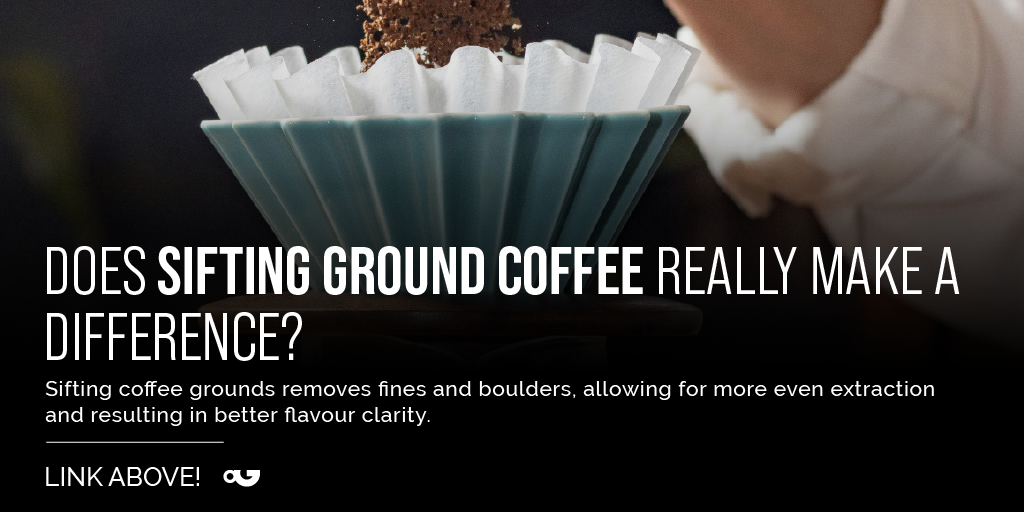
The pursuit of the perfect cup has always defined specialty coffee. From meticulous processing to dialling in espresso shots to the tenth of a gram, the push for precision is relentless. In recent years, this obsession has extended to what happens straight after grinding: sifting ground coffee.
Once confined to competition stages, the practice is now entering cafés and home barista setups worldwide. Sifting ground coffee promises more consistent extractions, cleaner flavours, and greater control over the brewing process.
However, it’s time-consuming, and some question whether the results justify the extra effort.
“Traditional particle sifters have long suffered from critical limitations: high tension, strenuous and time-consuming manual agitation, and significant waste,” says Jeff Kim Dong Wan, founder and director of Coffeez Inc., which designed the award-winning Duomo the Tamper and recently created Duomo the Sifter.
You may also like our article on why distribution and tamping are so important for quality espresso.

How fines and boulders affect filter coffee
The practice of sifting ground coffee gained traction largely through competitions. World Brewers Cup competitors, always seeking marginal gains, began experimenting with sieving their grounds to achieve a more uniform particle distribution. The idea spread quickly: if you can control particle size, you exert more control over extraction.
In practice, sifting uses dedicated mesh sieves to separate ground coffee into particles of different sizes. The two extremes that baristas target are fines and boulders.
Fines are dust-like particles that extract almost instantaneously, contributing harsh bitterness and astringency to the cup. Boulders, on the other hand, are oversized chunks that remain underextracted, producing flat, watery, or thin-tasting coffee.
Even premium grinders are not immune to producing both. Research published in Matter found that grinding coffee at finer settings increases the proportion of fine particles, creating a wider and less predictable particle size distribution.
By removing or redistributing these outliers, baristas can brew with a more homogeneous particle bed. The practical benefits include:
- Improved flavour clarity: a uniform grind allows individual flavour compounds, particularly nuanced acidity and sweetness, to express more distinctly. Research from the Specialty Coffee Association confirms that consistent particle size correlates directly with more predictable and balanced extraction.
- Better flow rate: fines are small enough to lodge in paper filter fibres, restricting flow and unpredictably increasing brew time. Removing them stabilises drawdown, particularly in pour-over methods like the V60 or Chemex.
- Reduced cup variance: when every particle extracts at a similar rate, brew-to-brew consistency improves significantly.


Overcoming a labour-intensive practice
The main obstacle to widespread adoption of sifting ground coffee has always been practicality. Traditional sifters require repetitive manual shaking, often for several minutes, and can trap significant amounts of coffee in the mesh sieves. Inevitably, this generates more waste and impedes workflow.
As a result, the practice of sifting ground coffee has remained at the periphery of daily café operations, largely reserved for competitions or slow-bar settings.
Jeff explains that Duomo the Sifter is designed to remove these barriers. “Using a proprietary, smooth-rotating mechanism, the device allows baristas to separate ground coffee particles by size with zero waste in under 20 seconds,” he explains.
“It’s built around a modular sieve screen system ranging from 100 microns to 1,500 microns. The base kit includes three universally applicable mesh sizes, with additional screens available separately to suit specific brewing methods, grinder outputs, or coffee types,” he adds. “This modularity means the tool can adapt as a barista’s technique evolves.”
Coffeez Inc. will preview Duomo the Sifter at World of Coffee Brussels from 25 to 27 June 2026. Standing over 30cm tall and weighing more than 1kg, the sifter is built for stability during rotation, with an official global commercial launch scheduled for the end of July 2026.

How can sifting ground coffee produce better extractions?
To understand how sifting can improve extraction, it helps to revisit the underlying chemistry.
Water dissolves soluble compounds from the grounds at a rate that governs coffee extraction. Particle size is one of the most influential variables in this process, because surface area and diffusion rate scale directly with particle size.
Research from the University of California, Davis demonstrated that grinding finer increases extraction yield but also introduces instability due to the disproportionate influence of fines on flow resistance.
In practical terms, when particle sizes are uniform, water moves through the coffee bed evenly, contacting each particle for a similar duration and extracting a balanced range of compounds. When sizes vary widely, however, water finds paths of least resistance through the fines, over-extracting them while bypassing larger particles entirely. This uneven flow, known as channelling, is a primary cause of extraction inconsistency.
The specialty coffee community’s growing interest in sifting reflects a broader demand for extraction control. Baristas are no longer satisfied with adjusting only grind size, water temperature, and brew ratio; they want to manipulate the coffee bed itself.
With that in mind, Jeff explains that Duomo the Sifter is designed to introduce an entirely new variable to coffee extraction. “Rather than simply discarding micro-fines, the device introduces Particle Layering,” he says. “In standard brewing, randomly mixed particles lead to unpredictable flow rates and cup variance. Duomo allows users to instantly group grounds into three distinct particle sizes to intentionally construct a custom extraction bed.”

Impact on flavour
Testing by CoffeeZ Inc. revealed that the placement of micro-fines within the bed changes the cup profile. More delicate coffees, particularly those with high aromatic complexity such as Geshas or washed Ethiopians, perform best when micro-fines sit at the top of the filter bed, where they first come into contact with water.
Other coffees, by contrast, achieve optimal sweetness and structural balance when fines sit at the bottom to be extracted last, as water finishes passing through the bed.
“By managing exactly where each particle size sits in the filter bed, professional competitors and home baristas can transcend the traditional constraints of temperature, grind size, and time to unlock the maximum flavour potential of exceptional coffees,” Jeff explains.
Beyond layering sequence, baristas can also fine-tune the proportion of fines included in the brew. For higher-density lots with tighter cell structures, such as competition-grade SL-28s or naturally processed Yirgacheffes, increasing the number of fines can compensate for lower solubility.
For lower-density or lighter-roasted coffees, which extract more easily, reducing fines prevents over-extraction and preserves brightness.

Sifting ground coffee is no longer only for competitions. The science behind particle uniformity and its effect on extraction is well-established, and purpose-built tools are now removing the practical barriers that once kept the technique out of daily café workflows.
For baristas working with exceptional coffees, the ability to customise the extraction bed itself may prove to be as significant a variable as any other in the pursuit of the perfect cup.
Enjoyed this? Then read our article on how channeling affects espresso extraction.
Sifting ground coffee FAQs
- What are fines and boulders, and why do they matter in coffee brewing?
Fines are tiny, dust-like particles that extract too quickly, adding bitterness and astringency. Boulders are oversized chunks that extract too slowly, producing flat or watery coffee. Both appear even with premium grinders and contribute directly to an inconsistent cup.
- Does sifting ground coffee make a noticeable difference to flavour?
Yes, when done correctly. Removing or redistributing outlier particles creates a more uniform coffee bed, which allows water to extract evenly. The result is greater flavour clarity, more predictable sweetness and acidity, and less variance between brews.
- Is sifting ground coffee practical for everyday use?
Until recently, it has not been. Traditional sifters require several minutes of manual shaking and generate waste. Newer purpose-built tools are addressing this, with some designed to complete the process in under 20 seconds with no coffee lost in the mesh.
Photo credits: Duomo
Perfect Daily Grind
Please note: Duomo is a sponsor of Perfect Daily Grind.
Want to read more articles like this? Sign up for our newsletter!
Source link