
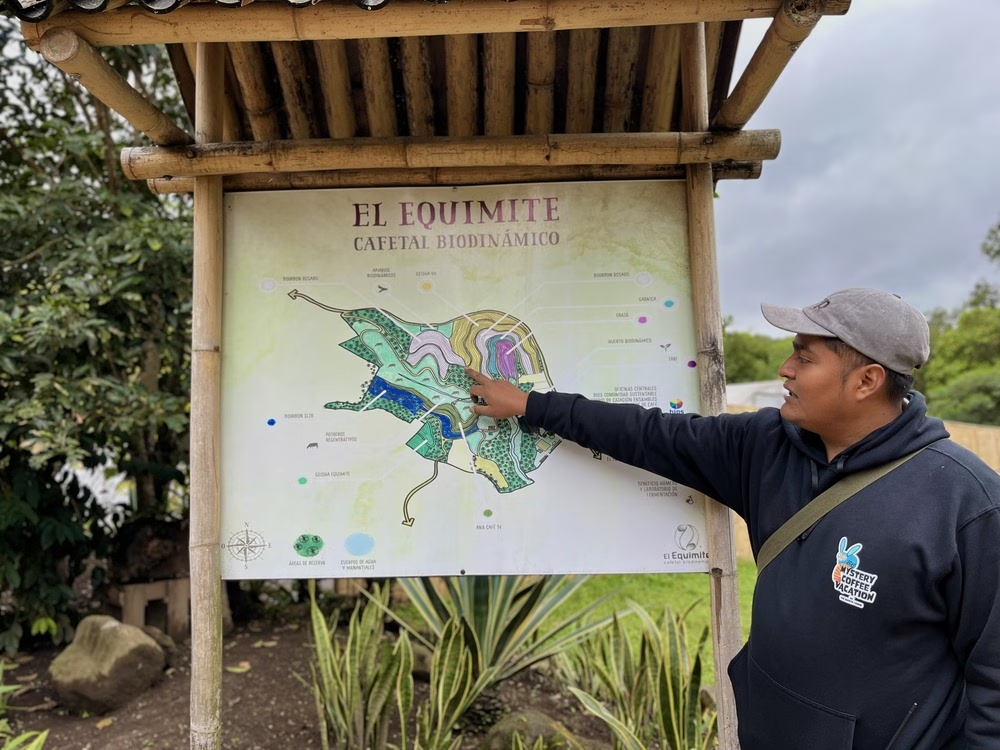
On a trip to El Equimite in Coatepec, Mexico, we learn about biodynamic farming—a regenerative form of agriculture that treats the farm as a living organism.
BY MELINA DEVONEY
BARISTA MAGAZINE ONLINE
Photos courtesy of Melina Devoney
What to know:
- This past January, The Barista League took their annual Mystery Vacation to a biodynamic coffee farm in Coatepec, Mexico, where TBL winners and Barista Magazine had the chance to tour the premises and learn about regenerative farming
- In biodynamic coffee farming, the farm is seen as a living organism, through which farmers communicate with the plant and animal worlds, and planting and harvesting is done in accordance with planetary phases
- Compared to conventional and organic farms, biodynamic farms are generally more climate-resilient and ecologically efficient
Without seeing biodynamic farming firsthand, many people discount this century-old farming methodology as “woo-woo.” Frequently, this stems from our misunderstanding of the spiritual principles of biodynamic farming. The reductionist approach of Western agriculture separates science from spirituality and limits our ability to measure the flow of life forces between living organisms. Although the biodynamic movement was started in 1924 by the Austrian agriculturalist Rudolf Steiner, Indigenous groups worldwide have maintained a spiritual responsibility for their food systems for millenia.
Today, biodynamic farming has gained mainstream popularity, and science has begun to back up many of its long-observed benefits.
Biodynamic farming was a mystery to most of us participating in The Barista League (TBL) Mystery Vacation at El Equimite hotel and biodynamic coffee farm in Coatepec, Mexico, this past January. During our week-long stay, we toured the farm and participated in a biodynamic soil-building ritual—which transformed our confusion into inspiration.

Biodynamic fundamentals—a marriage of science and spirituality
Biodynamic farmers assume a deeper responsibility for their environment than the more common philosophies of organic and regenerative farming. Organic, regenerative and biodynamic farming all avoid synthetic pesticides, herbicides, and fertilizers, as well as prioritizing soil health, biodiversity, and environmental sustainability.
Where organic generally aims to simply “do no harm” to the environment, regenerative and biodynamic aim to restore the farmland into a self-sustaining and interdependent ecosystem. Regenerative and biodynamic farms produce their own compost, animal feed, and fertilisers using on-site resources only. In contrast to organic farming, regenerative and biodynamic farming strictly limits the use of manufactured agricultural inputs, even those made of organic materials.
Biodynamic farming uniquely encompasses spirituality. Rather than looking to gods or spirits, biodynamic farmers believe that the farm is a living organism with flows of energy that transcend the material world. This spirituality is rooted in Steiner’s philosophy that humans are consciously intertwined with the land, plants, animals, fungi, microorganisms, and earthly and celestial rhythms.

Biodynamic agriculture encourages us to suspend our disbelief in the spiritual realm and reconsider our anthropocentric and purely-material explanation of the natural world.
“We are opening a dialogue between the plant world and animal world,” says El Equimite founder Gibrán Cervantes about biodynamic farmers. He believes in the spiritual connection between animals, plants, fungi, and soil, and their “communication that we can’t access but we can perceive—if we become aware,” he says.
The spiritual components of biodynamic farming are often disregarded as unfounded because they are largely immeasurable with modern science. However, there is scientific evidence for the ecological benefits of biodynamic farming. Compared to conventional and organic farms, biodynamic farms generally:
- Are more ecologically efficient and rely less on external inputs.
- Are more resilient to climate threats and pathogens.
- Foster higher microbial, plant and animal biodiversity.
- Show higher indicators of soil health.
- Enhance food nutritional quality.
- Sequester more carbon.

Biodynamic practices at El Equimite
El Equimite is a 34-hectare farm that is certified Organic and Biodynamic by Demeter—a rarity in Mexico.
“We (at El Equimite) work under four pillars: the relationship between the plant, human, the soil, and the cosmos,” says farm manager Germán García. “We work in a circular economy. Everything we produce in the farm we re-utilize for nutrition and to add value to the farm products.”
Nearly 40% of the farm is protected conservation area with zero crop cultivation or intervention. El Equimite is currently testing which of its 24 coffee varietals survive best in its microclimate. The forest is a biological corridor with upwards of 40 species of shade trees, a pond, and a garden with vegetables and medicinal plants.
El Equimite has documented 54 bird species including toucans and other endemic birds, armadillos, rabbits, ant eaters, coyotes, squirrels, badgers, raccoons and their adorable relatives, cacomixtles.
El Equimite’s 50% tree cover makes the local atmosphere very humid—good conditions for coffee plants, but also for coffee plagues. Without chemical or organic agricultural inputs, biodynamic farmers must stay vigilant against the many threats to coffee.

“Coffee leaf rust and different types of fungi and diseases are constantly a risk that need to be regulated and managed,” says TBL Europe winner Eline Ferket during the farm tour.
After coffee leaf rust swept through the farm several years ago, El Equimite successfully reduced the incidence of the fungus to 15-20% by applying a beneficial fungus to the leaves of infected plants to outcompete the plague.
A common misconception of biodynamic farming is that it requires animal sacrifice. In reality, the farmers’ only potential sacrifice is crop yields and profits. Particularly, high shade cover and low intervention can reduce coffee yields.
“Here is where our conscience comes in for the plants, soil and the environment,” says Germán, who prioritizes ecosystem health over profits.

“It’s thinking about the longevity of the farm, not just producing coffee,” says TBL Partnership Manager Ximena Rubio. “Everything’s connected, and it’s not just the plant and the human; it’s also the soil, the cosmos.”
Biodynamic farmers understand that cosmic cycles influence plant and soil nutrition, so they plant and harvest according to planetary phases. El Equimite farmers pick coffee on days flanking the full moon because its gravity pulls sugar from the plant roots to the fruit (similar to the moon’s influence on ocean tides). We taste-tested this phenomenon while touring the farm a few days before the full moon: “the coffee cherry is sweet and non-acidic,” says TBL Asia winner Kirill Gorelov.
During the tour, we witnessed how biodynamic farmers recycle resources to rebuild a self-sustaining ecosystem. El Equimite recycles coffee cherry pulp into compost, and the farm’s keyline water management design follows the contours of the landscape to channel rainwater and preserve soil structure.

Biodynamic preparations in the fladen ritual
Biodynamic farmers apply preparations of medicinal plants, manure and minerals in microdoses to the soil: dandelion, horsetail, nettle, chamomile, yarrow, oak bark, and valerian, silica, and more. The medicinal and energetic properties of each preparation stimulate microbial activity and nutrient cycling in the soil and are thought to be passed through the soil to plants and to whatever consumes them. Fermenting and “dynamizing” (energetically activating) herbs and minerals magnifies their properties. Gibrán explains that the preparations work in harmony; some work in the energy of expansion while others work in the energy of contraction.
Preparations are fermented inside specific animal “sheaths” each with their own energetic properties. For example, yarrow flowers are fermented within a deer bladder because deer, with horns that reach to the sky, have expansive cosmic energy just like the flowers, Gibrán explains. Oak bark is filled into the brain cavity of a livestock skull. The living brain is surrounded by the meninges, which protects it against infection. Gibrán explains that oak bark is placed into the brain cavity to re-enliven the protective microorganisms that once lived there.
The filled sheaths are dried for several months, and thereafter buried to ferment for six more. The fermented plant matter is removed from the sheath for use. Once mixed into farmland soil, each preparation has unique and extensive biological and energetic roles:
- Providing, liberating, and stabilizing nutrients in the soil for plants.
- Aiding decomposition of organic matter.
- Inhibiting fungal pathogens and pests and making plants more resilient to them.
- Supporting beneficial soil microbes.
- Balancing soil structure.

The common biodynamic fladen (“cow pat” in German) ritual incorporates preparations that promote the decomposition of the microbe-rich manure and compost into fertile soil in a matter of several months.
“We are going to do it with joyful intention, with music, with drums and dancing,” Gibrán says as he explains El Equimite’s fladen ritual.
We walked and danced continuously in a circle around a pile of cow manure to the beat of wooden drums. We sprinkled ground eggshells and basalt dust (both full of minerals) onto the manure and dynamized it by taking turns aerating it with shovels for an hour.
We simultaneously dynamized fermented and ground valerian flowers by shaking it in a bottle of water throughout the entire ritual.
“This is going to change the destiny of this manure because we are transforming, with intention, a raw material into a sacred material,” Gibrán says.

As a product of the cow’s powerful digestive system, the manure has strong terrestrial energy that completes the transformation of the fladen, Gibrán tells us. The harmony of minerals, herbs and organic matter in the fladen catalyze a cascade of microbial life: “If there is life, there is biological transmutation. And if there is biological transmutation, the plant knows what to eat from the soil,” Gibrán says.
We buried the dynamized fladen and microdoses of preparations in deep pits, and sprinkled valerian water on the top as an energetic seal. The ritual was complete – all that was left to do was wait.
“It’s very spiritual, and I think that’s something that none of us had considered was part of the coffee practice,” says TBL Pacific winner Emily Barker. “That is lacking from a lot of our cultures despite us all being from different parts of the world.”
“A lot of people could think that’s a bit crazy—to see all these people believe in and put in their energies into this process, and trusting this process, think it’s actually really nice and refreshing. … I’m inspired to learn more.”
Whether or not TBL participants believed in the agricultural effects of the fladen ritual, it surely had an effect on us. The intentional and immersive time spent with the soil endowed us with a feeling of responsibility for it. The conscious ritual decentered humans in the web of the ecosystem, and it cultivated our connection and appreciation for our food systems.
“Farms are living beings and we have to respect them—because they give us the opportunity to work in the soil, because we are going to turn into soil, too,” Gibrán concludes.
ABOUT THE AUTHOR
Melina Devoney (she/her) is a barista and freelance writer in Los Angeles zeroed in on coffee and agriculture. She aims to amplify the voices of farmers and a diversity of perspectives within the coffee industry, and she’s happiest when running on wooded trails and dancing at concerts.

Subscribe and More!
As always, you can get a hard copy of Barista Magazine by subscribing or ordering an issue.
Support Barista Magazine and show your love with a Membership.
Signup for our weekly newsletter.
Join us at Camp Coffee Shop Aug. 10-13 in Napa, California.
Read the April + May 2026 21st Anniversary Issue for free with our digital edition.
For free access to more than six years’ worth of issues, visit our digital edition archives here.
Source link