
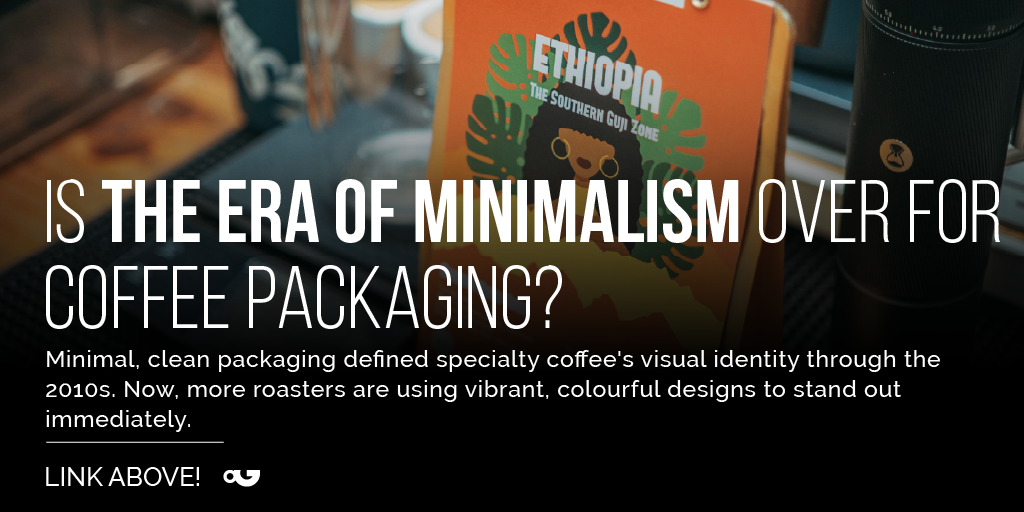
Key takeaways
- Minimalist coffee packaging applies a “less is more” design philosophy, using limited colour palettes, clean typography, and negative space.
- But Gen Z is driving demand for bold, identity-led packaging design.
- Maximalist coffee packaging is characterised by vibrant colours, illustrations, textures, and dense typography.
- Striking bags perform well on social media, extending reach beyond shelves.
During the 2010s, minimalist packaging reflected specialty coffee’s inward perspective. Roasters expressed only the most essential elements of their coffees through simple packaging design.
But after a decade of muted tones, clean lines, and simple typeface, less may not always be more.
Today, consumers, especially Gen Z, are rejecting minimalism in favour of bold self-expression. For roasters, loud, colourful coffee packaging is one of the best ways to catch their attention.
“A bag covered in illustrations and bright colours stops someone mid-scroll or mid-aisle,” says Mark Zhou, founder of MTPak Coffee. “Consumers can’t always taste the coffee before they buy, so the packaging does the selling.”
While the era of minimalism isn’t over in coffee packaging, maximalist design is often considered more authentic today, especially for newer brands.
“Minimalism works for some brands, but it requires an established reputation to carry it,” Mark explains. “For roasters building an audience, maximalist design communicates confidence and character from the first impression.”
You may also like our article on designing exceptional coffee packaging.

From minimalism to maximalism
Only a decade ago, most specialty coffee packaging looked similar: kraft paper, muted tones, clean typography, and plenty of negative space.
By removing small details, roasters placed greater focus on the coffee itself. Minimalist packaging matched the brand’s philosophy; terroir, traceability, and flavour were the selling points.
This design direction also reflected the consumers buying the coffee. Millennials, who grew up during the years of austerity following the 2008 financial crisis, were drawn to clean, understated design across all categories, including specialty coffee.
But by 2020, the “less is more” look had saturated packaging in coffee shops and supermarkets worldwide. Roasters operating in an increasingly crowded market began to look for other ways to differentiate, and bold, colourful, maximalist design emerged as a solution.
Maximalism is defined by excess, often through bold patterns, vibrant colours, and a fusion of textures, layering elements to create depth and complexity. Unlike minimalism’s focus on restraint, maximalism invites contrast, and eclecticism and abundance serve as a form of personal expression.
“Maximalist design works best when it matches the energy of the coffee inside,” says Keri Roberts, the co-owner and head roaster at Non-Conformity Coffee in Vancouver, BC, Canada. “When you’ve sourced something beautiful – a lot from a women-led farm, a harvest that only happens once a year, a relationship you continue to invest in – the packaging should reflect that significance.
“Bold, unapologetic design says: this was made with intention, and customers feel that before they even open the tin,” they add. “The farms, the process, the people behind the cup – there’s a real story at every step, and minimalist packaging struggles to hold all that.”


Why maximalism is trending in coffee packaging
The shift towards maximalism in coffee packaging is part of a wider cultural turn across fashion and interior design.
Gen Z in particular is pushing the fashion industry into bolder territory. From chaotic layering to clashing patterns, this generation is rewriting the rulebook, shifting away from “quiet luxury” in favour of bold, expressive, and intentional design and fashion choices.
Crucially, Gen Z’s preference for maximalism is rooted in identity and self-expression, and bold, bright coffee packaging speaks directly to this.
“Maximalist packaging feels personal,” Mark explains. “It carries a point of view, and consumers respond to that because it gives them something to identify with beyond the product itself.”
To celebrate the very best designs, features, and innovations in coffee packaging, MTPak Coffee launched the World’s Greatest Coffee Packaging competition earlier this year.
Washington’s Ember Goods was the winner, awarded for its creative matchbox design, which incorporates used coffee grounds. Non-Conformity Coffee received an honourable mention for its bold metal tins.
Maximalist packaging can also extend beyond the initial purchase, becoming an ongoing marketing tool for roasters. “People keep bags they love,” Mark says. “They photograph them, display them on their kitchen counters, and share them online.”

Authenticity matters in packaging design
For roasters, the benefits of maximalist coffee packaging are clear. But this design style’s confident and bold approach can be intimidating.
“Start with sentiment, not trends,” Keri suggests. “Maximalist design done well is deeply personal. If you’re going bold because you saw another roaster do it, that will show. The best packaging looks like it could only belong to that brand.
“We’re queer founders, and there’s something you learn early when you exist that way: you don’t get to be bold by accident,” they add. “It means we’ve never been willing to shrink to make other people comfortable, and our logo and coffee names reflect this.”
This level of authenticity is crucial for younger consumers. In a recent survey of 800 Gen Zers, 47% of respondents agreed that a brand that advertises around an unrelated cause is engaged in sales ploys rather than a genuine commitment or value.
“Ask yourself why you’re being bold. For us, the answer was simple: we show up loudly in our packaging because we show up loudly everywhere,” Keri says. “The design is consistent with the people making the decisions, and that kind of alignment is hard to fake and easy to feel.”
How to design maximalist coffee packaging
Focusing on maximal colour, lots of imagery, and illustrations is useful as a reference point. Custom artwork creates a visual identity that is hard to replicate and immediately communicates personality.
“Trust your typography,” Keri adds. “Strong type does more work than people expect. A confident typeface, a bold colour choice, and intentional information result in a design that knows what it’s saying.”
Material and finish decisions are just as important as the graphic design itself. “We help roasters choose laminates and finishes, such as matte, gloss, soft-touch, that make the design feel as good as it looks,” Mark says. “Small-batch roasters often think this level of print quality is out of reach, but MTPak Coffee offers low minimum order quantities so that independent roasters can access the same design fidelity as larger brands.
“We also offer full customisation on bag size, material, finish, and structure, so a roaster doesn’t need to adapt their design to fit a template.”

Minimalism and maximalism continue to co-exist in coffee packaging design, but it’s evident that consumers are currently gravitating towards loud, bold, and eccentric packaging.
For roasters, this is an opportunity to showcase their authentic brand story in seconds – without overthinking it.
“Don’t design for consensus,” Keri concludes. “The moment a concept goes through twelve rounds of feedback, trying not to offend anyone, it becomes beige. The designs that get remembered are the ones where someone said, ‘This is it’ and meant it.”
Enjoyed this? Then read our article on how roasters can use packaging to sell coffee for more.
Maximalist coffee packaging FAQs
- What is maximalist coffee packaging?
Maximalist coffee packaging is defined by a deliberate embrace of excess. It incorporates bold patterns, vibrant colours, and a fusion of textures, layering elements together to create depth and complexity.
- Why are more roasters choosing maximalism over minimalism right now?
Maximalist design is rising in popularity as younger consumers demand a wider range of design and colour. Gen Z in particular responds well to it, drawn to brands with a clear and expressive visual identity.
- What practical steps can roasters take when designing maximalist packaging?
First, invest in custom artwork and illustration to build a visual identity that is hard to replicate. Second, pay attention to typography and colour. Third, don’t overlook material and finish choices, including laminate and matte or gloss finishes.
Photo credits: Non-Conformity Coffee, Living Millennially
Perfect Daily Grind
Please note: MTPak Coffee is a sponsor of Perfect Daily Grind.
Want to read more articles like this? Sign up for our newsletter!
Source link