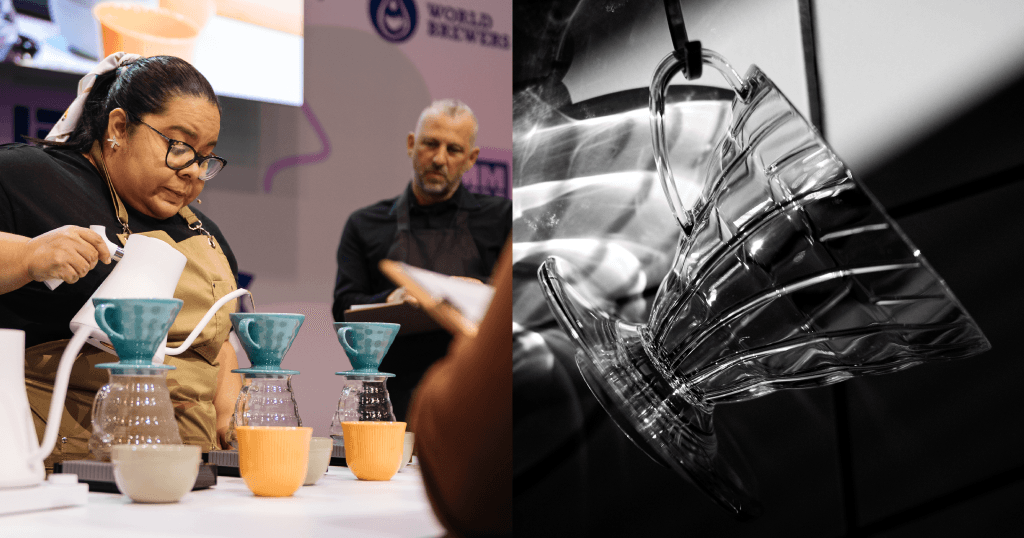
Since gaining global recognition at the inaugural World Brewers Cup, the Hario V60 has become a symbol of precision and craftsmanship in specialty coffee. Often found in both coffee shops and home brewing setups, the device is synonymous with the highest standards of manual pour over brewing.
Its iconic cone shape and spiral ribs have inspired an ever-growing range of recipes and brewing techniques with varying levels of precision and intricacy. Baristas, home brewers, and competitors continue to gravitate towards the V60, driving recipe development and innovation.
I spoke to Elysia Tan, co-founder and director of Homeground Coffee Roasters, Matt Winton, the 2021 World Brewers Cup Cup Champion and co-founder of Rose Coffee Roasters, and Masha Zanozina, a World and US Brewer’s Cup head judge and coffee educator, to learn more.
You may also like our article on the future of filter coffee.

Looking back at the V60’s impact on specialty coffee
Founded in 1921, the Japanese company Hario originally specialised in manufacturing laboratory glassware. By the 1940s, the company began designing and producing coffee equipment.
Some four decades later, Hario developed its first conical brewer, which used wire rods to support a paper filter. In 2004, Hario introduced the ceramic V60, which quickly gained the attention of coffee professionals and enthusiasts in Japan and beyond. Today, the device is available in different materials, including glass, metal, and plastic, allowing for versatility in aesthetics, heat retention, and recipe development.
“If you ask anyone to name the most classic pour over device, I guarantee that most people will say the V60,” says Masha Zanozina, a World and US Brewer’s Cup head judge and coffee educator. “I believe the Hario V60 is one of the first pour over brewing devices which made it to the international market and quickly became popular among coffee shops and home brewers.”
The V60’s design was revolutionary in several ways. The angle of the cone-shaped brewer results in optimal brew bed depth, especially for smaller doses. The spiral ribs create air pockets that prevent the filter from sticking to the sides, while the one outlet at the bottom streamlines the water flow.
“It’s a popular brewer because of its availability and accessibility,” says Matt Winton. He is the co-founder of Rose Coffee Roasters in Zurich, Switzerland and a seasoned coffee competitor. Matt won the 2021 World Brewers Cup (WBrC) using a metal Hario V60 and a natural-process eugenoides from Finca Inmaculada in Colombia.
“It started as a great dripper in its design and quality. As more people started to use it, it’s become a highly recommended brewer for beginners to specialty coffee,” Matt adds.


Precision as standard
Beyond coffee shops and home brewing setups, the V60 has become a prominent fixture at competitions, especially the World Brewers Cup. Six winners used the brewer in their WBrC routines between 2011 and 2021, cementing its position as one of the industry’s most beloved manual pour over devices.
A number of these winning performances have resulted in advanced recipes and pouring techniques, most notably 2016 champion Tetsu Kasuya’s 4:6 method and Matt Winton’s five-pour recipe.
Its presence at prominent competitions has influenced V60 recipe development more widely, encouraging coffee professionals and enthusiasts to experiment with a wider range of variables.
“I’ve been a part of the World and US Brewers Cup competitions for the last eight years. From my experience, competitors keep pushing the boundaries of what we’ve always considered the ‘norm’ or ‘rules’ of brewing,” Masha tells me. “They introduce different ratios, grind sizes, water chemistry, water temperatures, and levels of aeration to improve the aroma and/or texture of the coffee. Their decisions are always intentional.
“In cafés, I see more baristas using different coffee-to-water ratios rather than the classic 1:16, tweaking variables depending on the coffee they are working with and the results they are trying to achieve,” she adds.
The brewer’s cone shape, 60º angled walls, and spiral ribs lend themselves well to a range of pouring techniques, including different levels of agitation and flow rate, which grant the user more control over extraction.
“Coffee brewing has become more technical and data-driven. As people from various backgrounds have gained interest in brewing, they have shared unique insights and perspectives based on their expertise,” says Elysia Tan, co-founder and director of Homeground Coffee Roasters in Singapore. She is also the 2022 World Brewers Cup second runner-up and the 2019 & 2022 Singapore Brewer’s Cup Champion.
“People have also become more adventurous and experimental, which has led to evolving brewing methods,” she adds.

Coffee professionals offer their brewing tips
Although the V60 is often touted as an entryway brewer for those new to specialty coffee, the WBrC’s influence has led to increasingly intricate recipes that typically require more advanced brewing skills.
First and foremost, understanding how the different materials influence extraction is key.
“The different models – plastic, glass, ceramic, and metal – all have different thermal conductivity properties, as well as the physical depth of the ridges and the dimensions of the cone,” Matt says. “For my 2021 WBrC routine, we found that the metal V60 gave us a brighter, cleaner profile compared to ceramic or glass.
“The metal design is sturdy and absorbs heat quickly, so it’s a great starting brewer. The only issue I found is that its ridges are less pronounced than the ceramic and plastic models, so there’s a greater chance that the paper filter will sink into the gaps, which would negatively affect the brewing process,” he adds. “Always make sure the paper filter is sitting off the ridges as much as possible.”
Elysia also agrees that temperature is an essential variable to control to stabilise heat retention, saying, “You must pay attention to the brewing temperature when using the V60 with different materials. With a plastic V60, I recommend a lower brewing temperature than ceramic or metal, as plastic is a better heat insulator.
“To reduce variances in brewing temperature, I use room temperature water to rinse paper filters,” she adds. “This ensures the initial temperature of the V60 remains consistent, which helps improve extraction consistency.”
As with any manual pour over device, grind size and agitation are two of the most important parameters to tweak and monitor, but they are especially influential in the V60 brewing process.
“If you are using a coffee that you have never brewed before and are not sure if you chose the correct grind size, you can increase or decrease the extraction by increasing or reducing agitation,” Masha says.
“Controlling your flow rate is important. If your water is drawing through the coffee bed too quickly, you can gently swirl the brewer to add extra agitation,” she adds. “Always pay attention to flow rate and make sure the coffee bed doesn’t get fully dry between pulse pours.”
New brewers are redefining the V60 experience
Even with various materials impacting heat retention and bypassing, using different V60 brewers generally yields similar results. However, with the introduction of the Hario Switch, a V60-style brewer that combines immersion and drip extraction (similar to the Gina), baristas can experiment with variables like body and sweetness.
“With the launch of the Hario Switch V60, new possibilities and brewing variables have emerged. Besides percolation, we can now use immersion brewing as well,” Elysia says. “First, determine whether your coffee brews better with immersion or percolation.
“This will help you decide whether to use a regular V60 or a Switch. Some coffees require longer contact time, so immersion brewing might be preferable.

The V60’s versatility allows both skilled and less experienced baristas and home brewers to develop their own recipes, with the option to hone in on specific variables to yield different results.
“Learn how the six main variables of brewing – coffee-to-water ratio, grind size, time, agitation, water quality and water temperature – work in tandem with each other and how they affect extraction,” Masha concludes. “There is no one way or rule to brewing the perfect cup of coffee.”
Enjoyed this? Then read our article on how pour over brewing is changing.
Photo credits: Specialty Coffee Association
Perfect Daily Grind
Want to read more articles like this? Sign up for our newsletter!
Source link